
Visiting St. Paul Island, Alaska
When I was a child, my parents encouraged me to read National Geographic magazines that my father had from the publication's beginning. He lovingly and with great respect, had each year's issues leather-bound and had moved them into my bedroom as that was the only space available in their small New Jersey post-WWII home.
There were strick rules about when to go to bed and sleep but somehow these were overlooked if I was into another National Geographic story. These stories led to my interest in Arctic and Antarctic organisms and their adaptations and thanks to the National Science Foundation, led to research and teaching opportunities in the Antarctic. But I was never able to get to the Arctic to seriously explore its biology.
After retiring from my Professorship at the University of California, Santa Cruz, Ecology and Evolutionary Biology, I decided to explore the Arctic and other Antarctic regions with my cameras and like-minded photonaturalists, focusing on the effects of climate change on their wildlife. From my early readings of National Geographic stories, I remembered clearly the discovery of the last Woolly Mammoth that was found on St. Paul Island in the Pribilof Islands. Of course, I was fascinated, wanting to know, and much later learning, how they came to be on this island and what caused its demise about 5,700 years ago. Like other mammals, they migrated across sea ice when the Bering Sea was much colder than today, Their demise was attributed to climate change. Warming during a subsequent climate period reduced available freshwater on the island and the last of the Woollys died of thirst.
Climate change - primarily warming and the associated sea-level rises continues to do an number on this island and its inhabitants. One of the more recent episodes occurred between October 2016 and June 2017 when massive die-offs of Puffins occurred. Water temperatures had increased and as a consequence their food source had crashed. Few of the Puffins that annually returned after 9 months wintering at sea came back to their life-long St. Paul nesting sites. Puffin populations are just beginning to recover nearly a decade later.
Another example of the effects of climate warming is seen in the increase in rats on St. Paul Island. Rats are ruthless predators of nesting bird eggs and their new hatchings and until recently, they were unable to survive the winter temperature of St. Paul Island. But with warming, they have adapted and rat predation of seabird colonies and terrestrial nesters has become a real problem for the birds. But some measures have been undertaken to reduce the introduction of rats. Worldwide rats are one of the most devastating menaces of birds particularly on islands such as New Zealand, Hawaiian Islands and the Pribilofs and Aleutians.
St. Paul Island (June 2012) was my first of now many photographic trips to the Arctic as well as additional trips to the Antarctic (more on this in another post next year). I joined other photonaturalsts in Anchorage and flew on a small plane the 3.5 hours out into the middle of the Bering Sea.
The small plane barely had room for the 5 of us traveling from Anchorage and after much discussion and consternation, the airline took our camera bags to travel via another plane. We arrived and most of us got our luggage and camera gear (camera bags thrown from plane into pickup truck much to our horror). One collegue's bag with tripod and other equipment was lost and may still be in Anchorage!
We arrived and checked into our lodging at the King Eider Hotel which is connected to the tiny St. Paul airport. This is the only place to stay on the Island and we all ate at the Trident Seafood Cannery during our stay (the only restaurant on the island). Be aware that reservations are required if you intend to visit the island. Also, summer weather there is very foggy making photography difficult at times. More problematic is that the airport lacks radar so in the case of fog, planes cannot get in or out and delays should be expected. We had to wait several extra days to depart back to Anchorage and our baggage did not make it to Anchorage for another day requiring us to stay in Anchorage an extra two days to wait for our luggage (including all our camera gear).
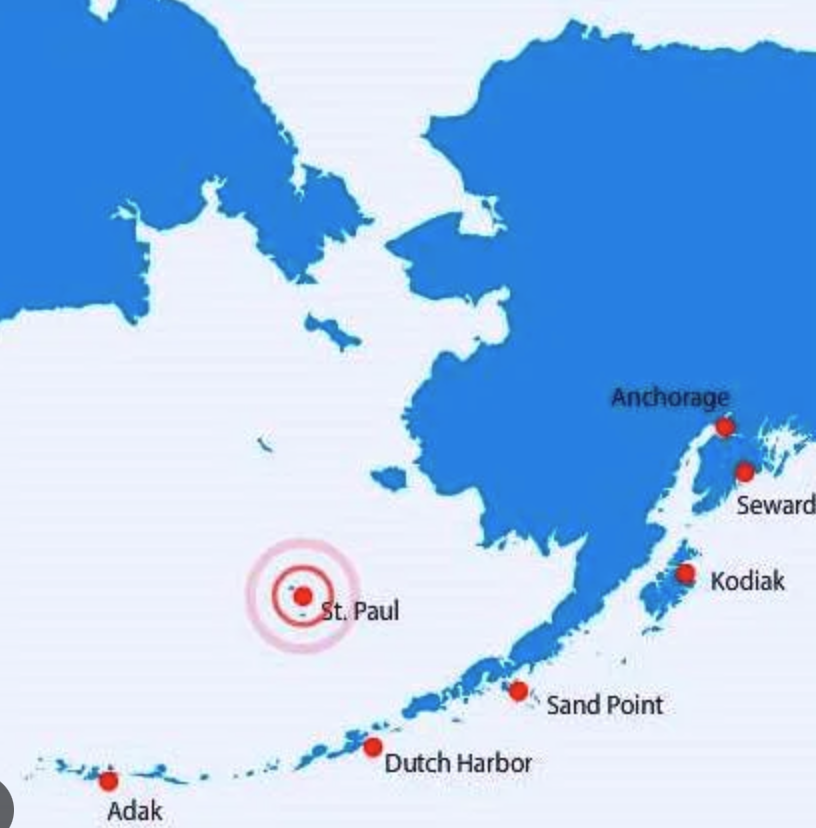
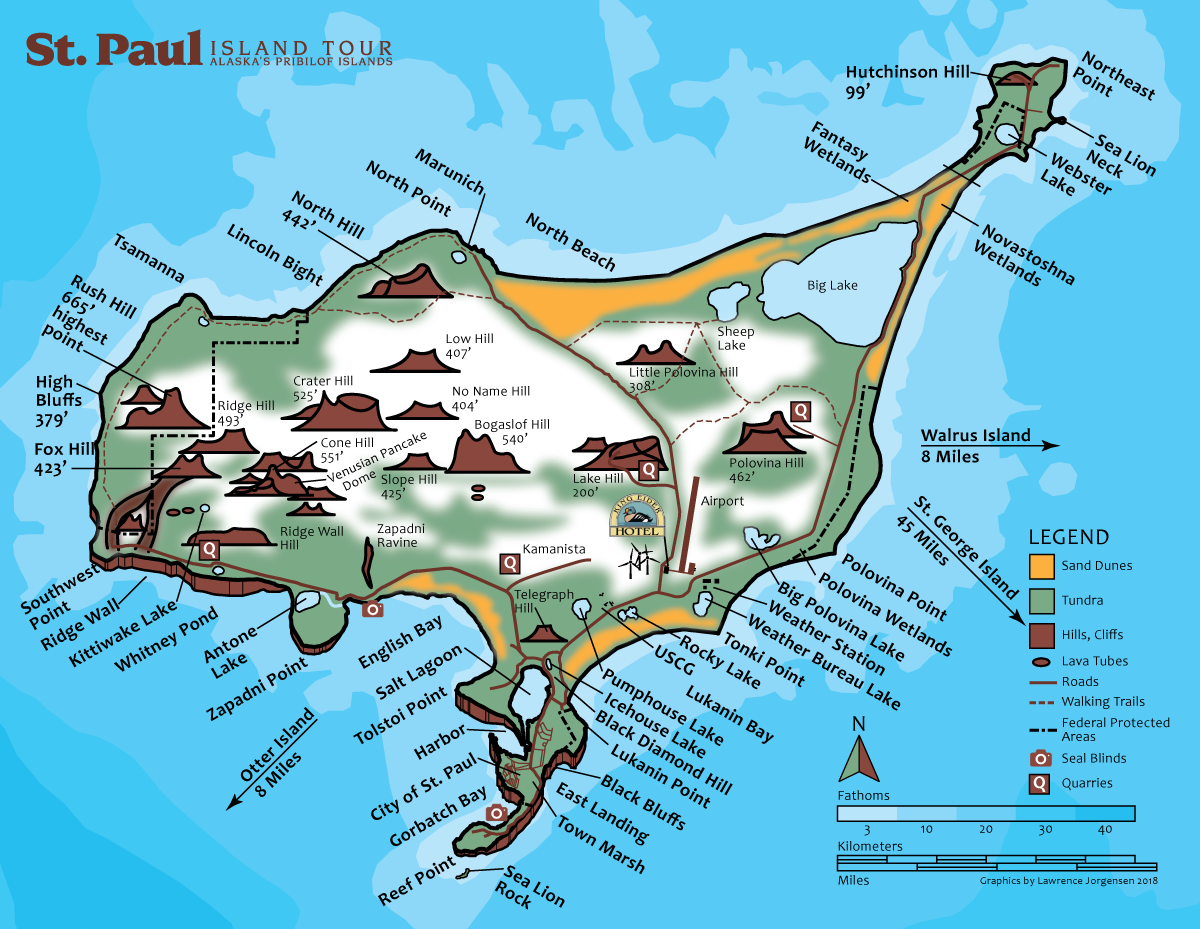
St. Paul Island is one of several islands (St. Paul, Walrus, Otter and St. George Islands) situated on a geological marine ridge in the Bering Sea. Together they are part of the Pribilof Island Archipelago and are part of the Alaska Maritime National Wildlife Refuge. St. Paul Island is 43 square miles in size and of volcanic origin (low profile shield volcanos) with more than a dozen cindercones and craters dotting the island.
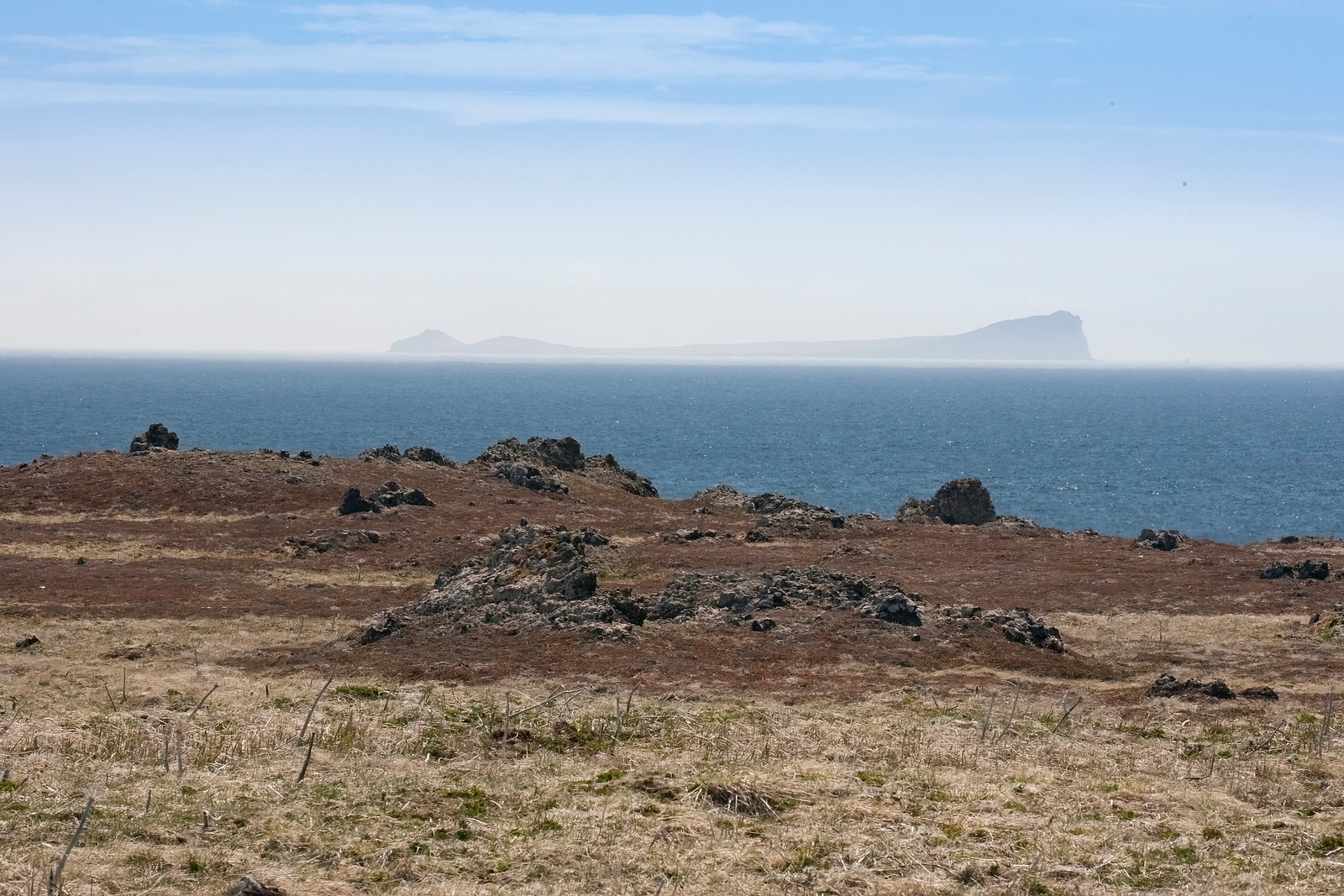 Volcanic rock, embedded in uplifed ancient marine sediments cover most of the island. Grasses, sedges, rushes, small shrubs and more than 100 species of arctic wildflowers and 100+ species of lichens form the coastal tundra communities. One of the other Pribilof islands is seen on the horizon.
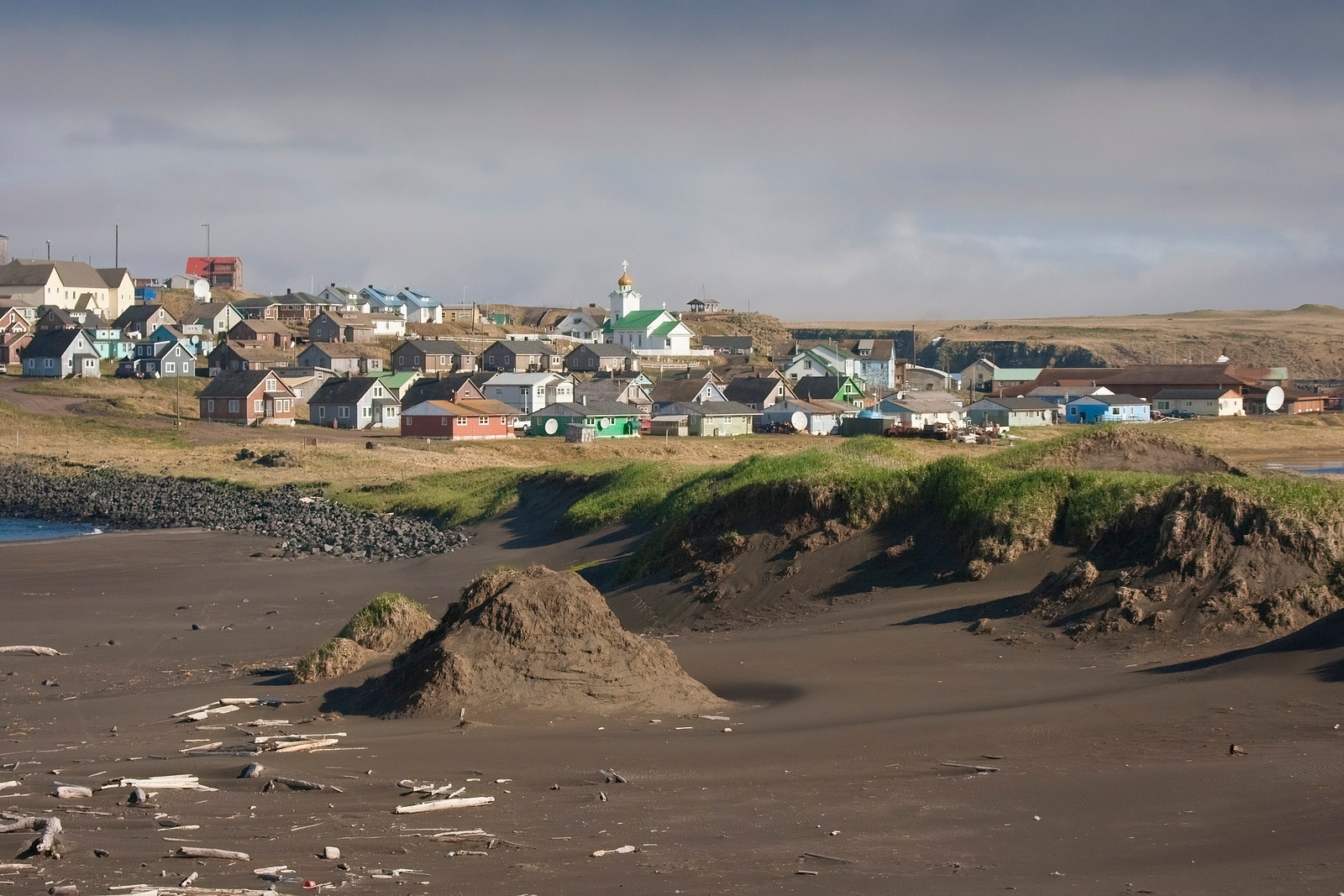 The little town of St. Paul is situated on the southern penninsula of the island. In the 2020 census, 416 people were recorded. It is the largest community of Aleuts in the US. The Russian Orthodox Church in the center of the town is a reflection of the history of St. Paul when it was a large center for Russian-dominated Fur Seal harvesting that almost whipped out the Northern Fur Sea Bering Sea population.
Wildlife of St. Paul Island
St. Paul and the other Pribilof Islands are surrounded by incredibly rich fishing grounds and home to about half million Northern Fur Seals of which thousands come ashore to birth their pups. Whales are abundant in these waters as well as Harbor Seals, Sea Lions and beneath it all, more than 350 shipwrecks. Millions of birds pass through and over this island. Some stop to rest during their migrations and many use this island for breeding. 326 species of birds are recorded from this island, including several Eurasian species that are of special interest to many "Big Year Birders" who we met in the field or in the Trident Seafood Cannery's cafeteria where we all ate.
The abundance of birds in such a small area encompassing so many different habitats as well as the location of this island make it a destination for anyone interested in observing and photographing birds. The ABA (American Birding Associaton) describes it as "One of those places that's for the birds." It's importance ecologically has made it a Internationally designated "Important Bird Area."
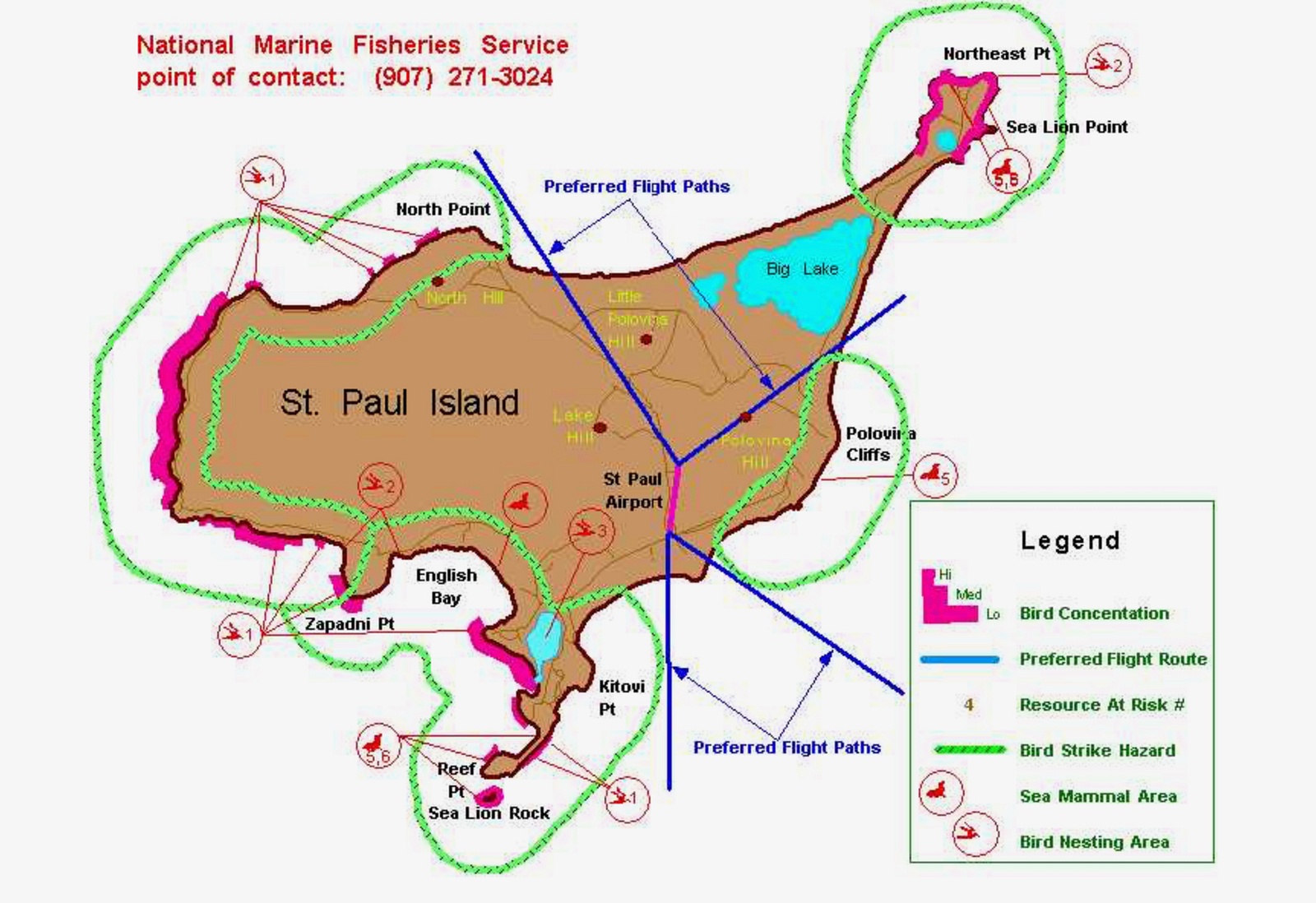 This map shows the bird concentrations, nesting areas and sea mammal areas of St. Paul Island. (from Integrating Research and Education: Impacts on American Indian Lands: Pribilof Islands).
Over my 10+ days on the island, my photography sites were primarily those where there were medium to high bird concentrations and bird nesting areas. These included Reef Point where both Horned and Tufted Puffins were nesting as were Parakeet and Crested Auklets. The shear cliffs at Zapadni Point and further north were full of nesting Murres (Common and Thick-billed), Northern Fulmur, Red and Black-legged Kittiwakes, and several other nesting species. In their classic 1955 book "Wild America", ornithologists Roger Tory Petersen and James Fisher wrote of these cliffs that they were "stunned" by the shear number of birds occupying every nook and cranny of these cliff walls." Many of these cliffs are more than 100 feet high - with a shear drop into the sea. Hanging over these cliff edges with long lens was not easy, particulary for one such as myself who does not like high places!
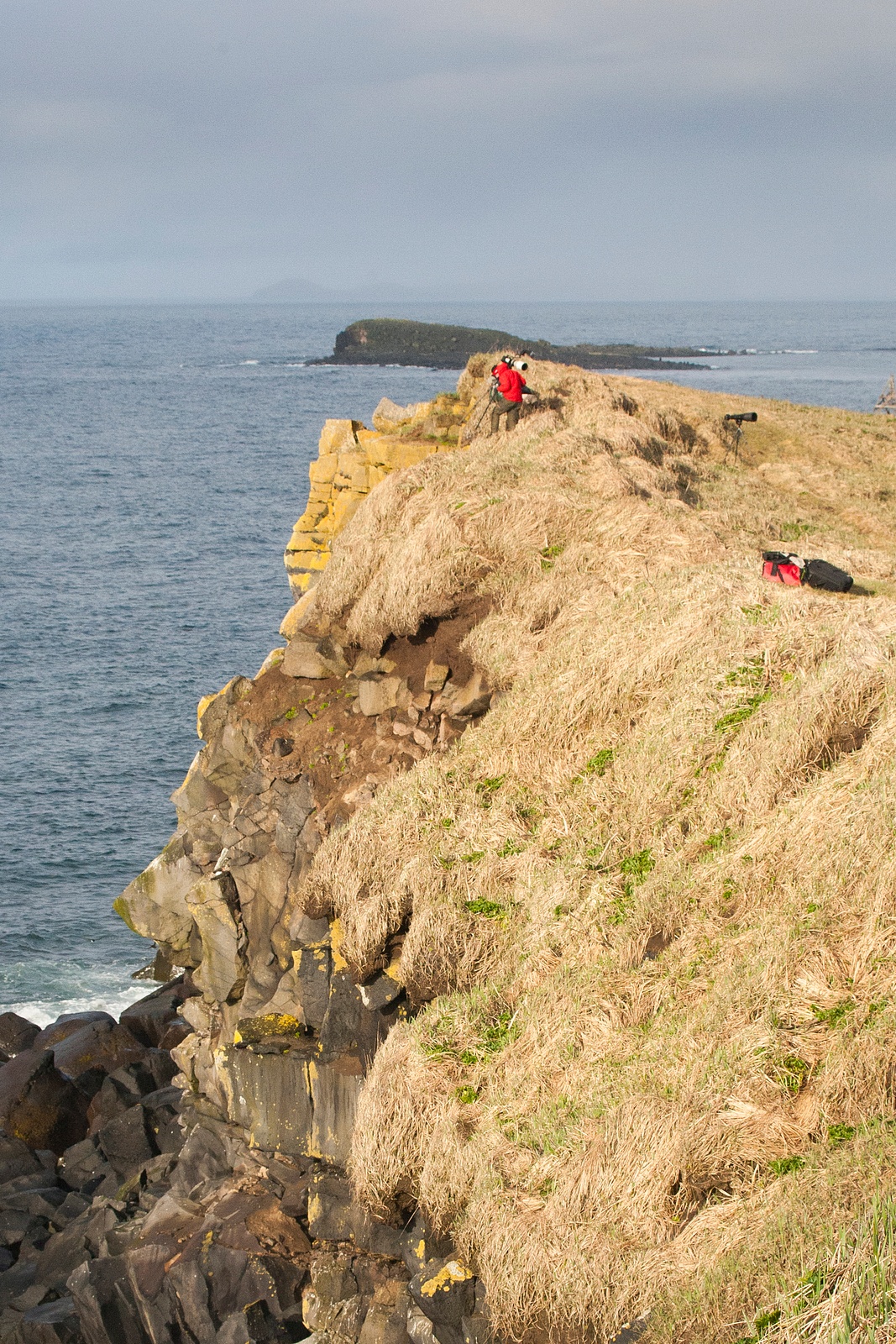 This is one of the smaller cliffs at Reef Point where we photographed nesting Puffins and Auklets. The small island off the point is Sea Lion Rock, part of a chain of rocks that extend way out to sea along the marine ridge. Otter Island is seen far in the mist.
Reef Point Breeding Birds
Puffins
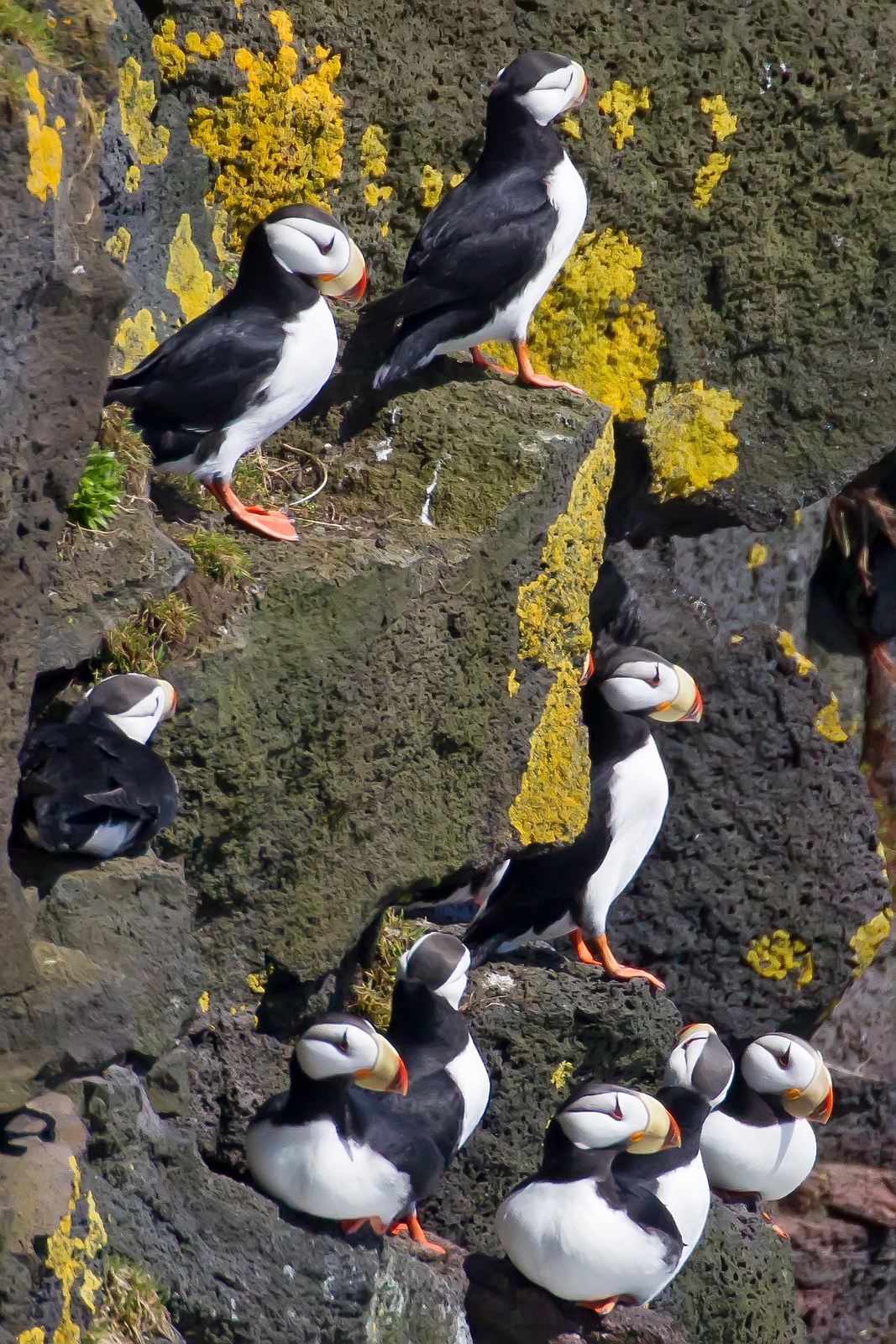
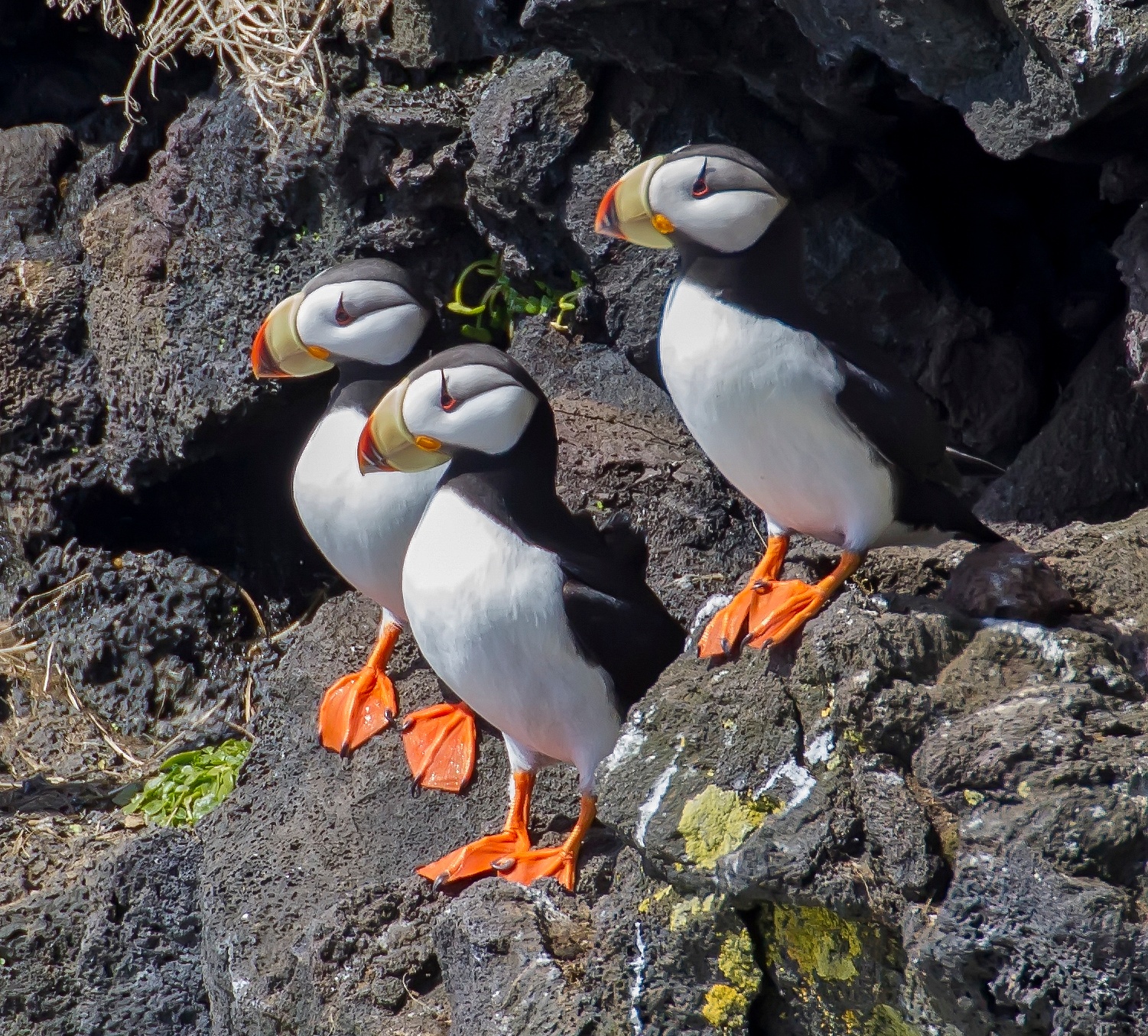
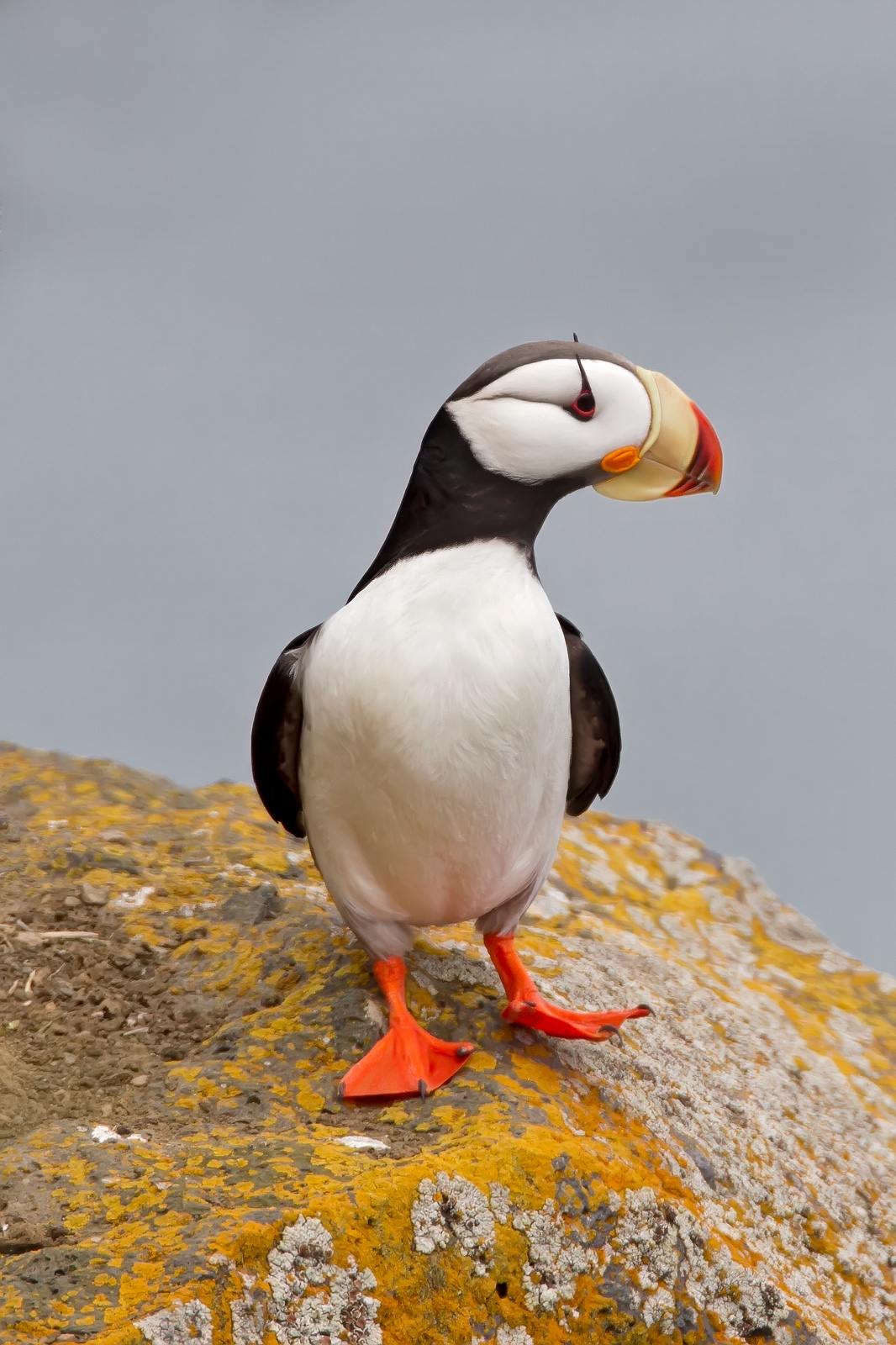
Horned Puffins (Fratercula corniculata) In breeding plumage, Horned Puffins have a clown-like face and bright orange feet and legs. This species occurs only in the north Pacific Ocean. The highest numbers are found in the NE Pacific along coasts of Kamchatka, Kuril Island and Sakhalin and in the NW Pacific along the Alaska coast, BC to northern California. Their appearance is similar to the Atlantic Puffin but the two differ in size (Horned is 14-16" and Atlantic is 10-11") and the coloration at the base of their bills. The "horn" above their eyes are small fleshy protuberances that are evident only in breeding birds.
They spend most of their lives generally alone at sea. well away from land - past the edge of the Continental shelves. Early spring they return to their places of birth and find their monogamous mate. Pair-bonding is reinforced by "bill-touching" and "bill-knocking" behavior. A pair will lay a single egg a year and after hatching both parents feed the juvenile, bringing fish and invertebrates (sandeels,, capelin and copepods, squid) of increasing size and feed the chick directly, not by regirgitation.
At the summer's end, the single chick leaves the nest during the night, and dives off the cliff to splash into the waves and swim off (first swim of its life) to its new independent life. It will not return to land again for several years until it is ready to breed.
🕊️🕊️🕊️🕊️🕊️
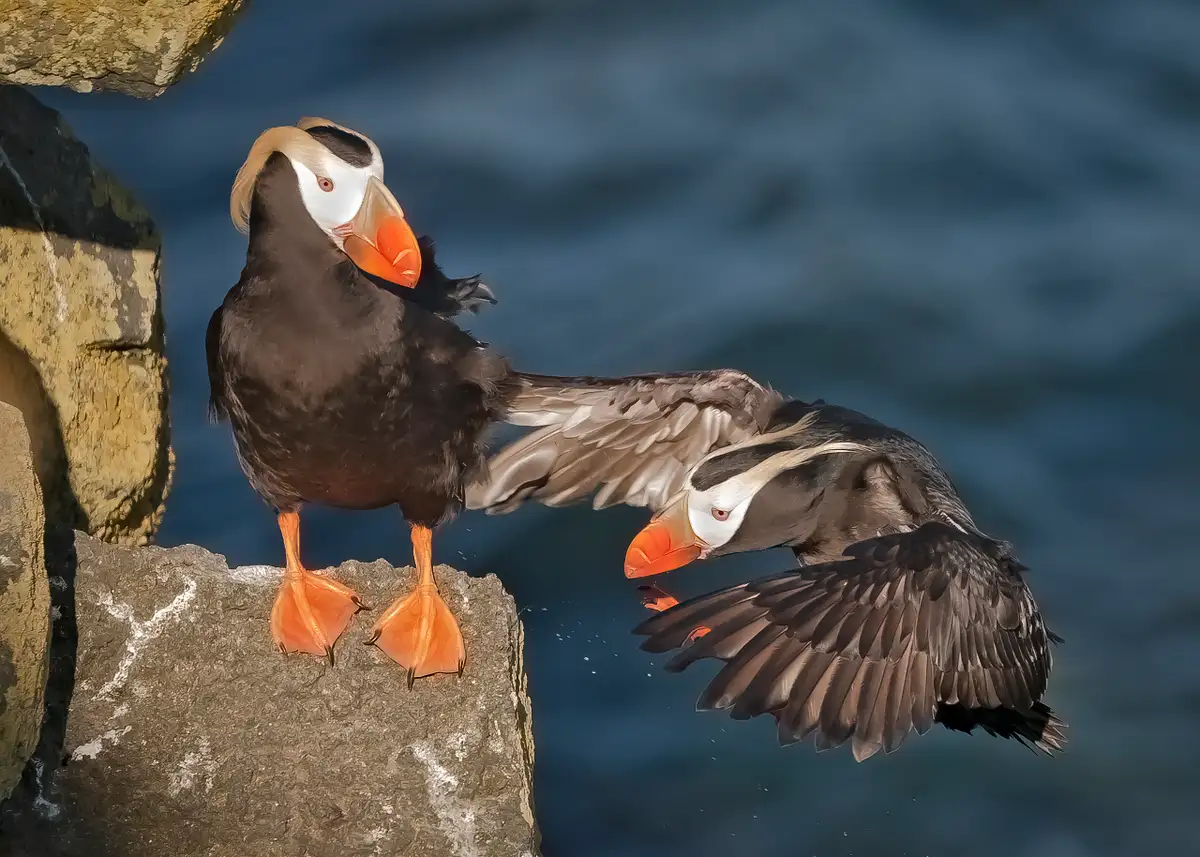
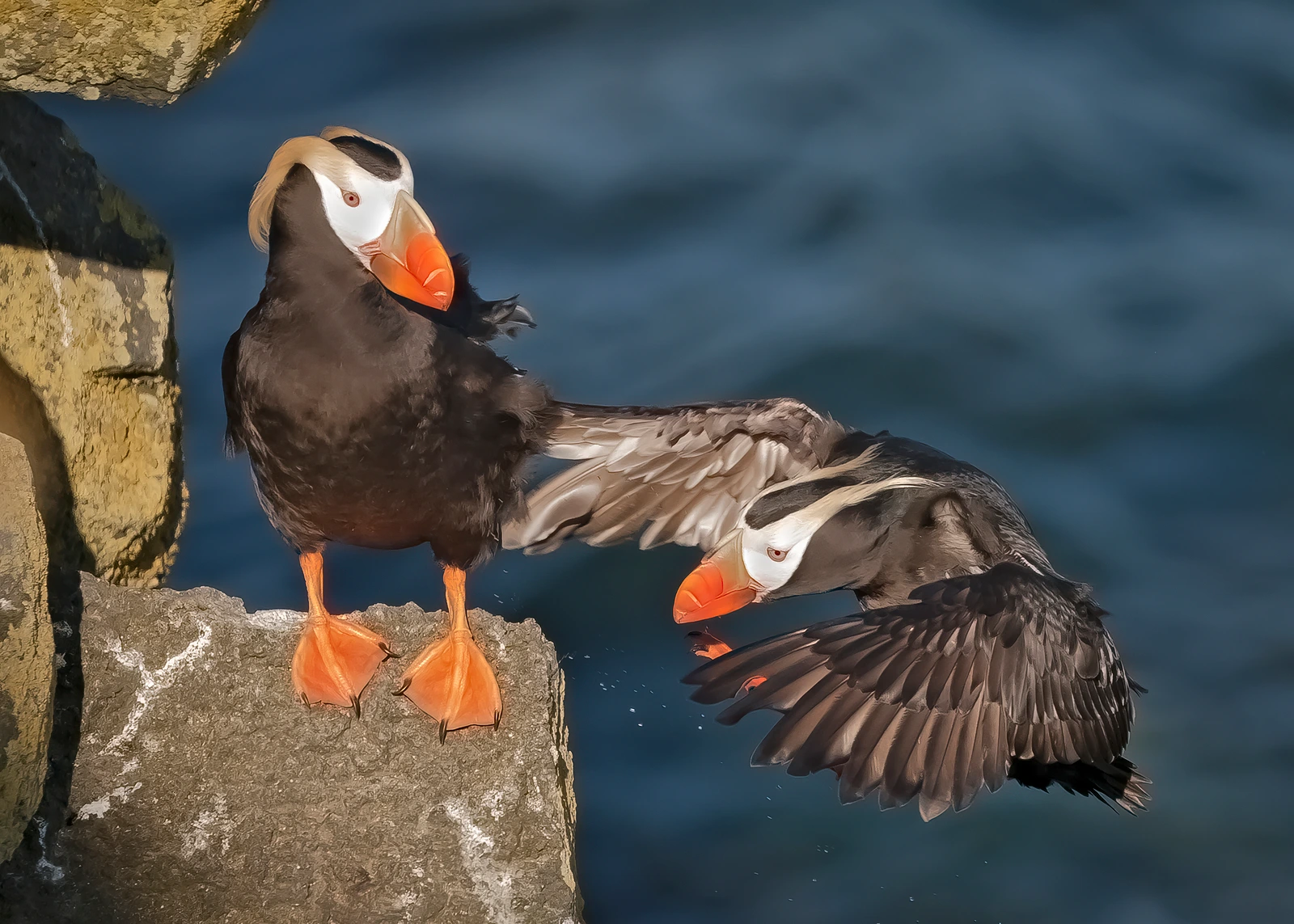
Tufted Puffins (Fratercula cirrhata) are the largest of the 3 Puffin species. They are chunky, football-sized birds and are all black except for their face and colorful, laterally flattened bill and spectacular, golden head plumes that are seen only in breeding birds. They have the most extensive breeding distribution of all puffins, breeding on offshore islands and headlands along the Alaska coast including the Aleutian and Pribolof Islands, the Pacific coast south along BC, Washington, Oregon (Hay-stack Rock population and Cape Perpetua) and to central California. Loss of habitat, climate change and the resultant decrease in food and increases in foxes and rats, particularly on islands have dramatically lowered their historical number in many areas.
They spend most of the year alone, foraging usually in the deep northern Pacific waters far off the continental shelf. They forage by "flying" underwater, grabbing fish (sandlance = sandeel, capelin, smelt, rockfish, squid and crustaceans) and feeding on them underwater. In late spring they return to their island and coastal burrows or rock crevices and meet up with their life's partner. The noise when they return to their nest site is absolutely joyous and after a noisy greeting, they renew their pair-bond by loud bill knocking (photograph 3 below) and ultimately gentle touching of bills.
They nest on rock cliffs preferring those with grass areas on cliff tops. Both the male and female excavate the burrow, which is often the nest or near the nest previous years. One egg is incubated by both parents for 40-45 days. When hatched, both parents feed the chick by flying in with fish and dropping them at the opening of the burrow and near the nest and immediately flying away to continue fishing. When the chick is ready to fledge, it does so at night, diving from the high cliff to take its first swim in the north Pacific, swimming and flying far offshore to areas of the deep northern Pacific. They will stay out to sea for more than two years, usually alone, feeding in this region before they return to land to breed. Generally a pair produces only one chick a year though in California, some second broods have been observed.
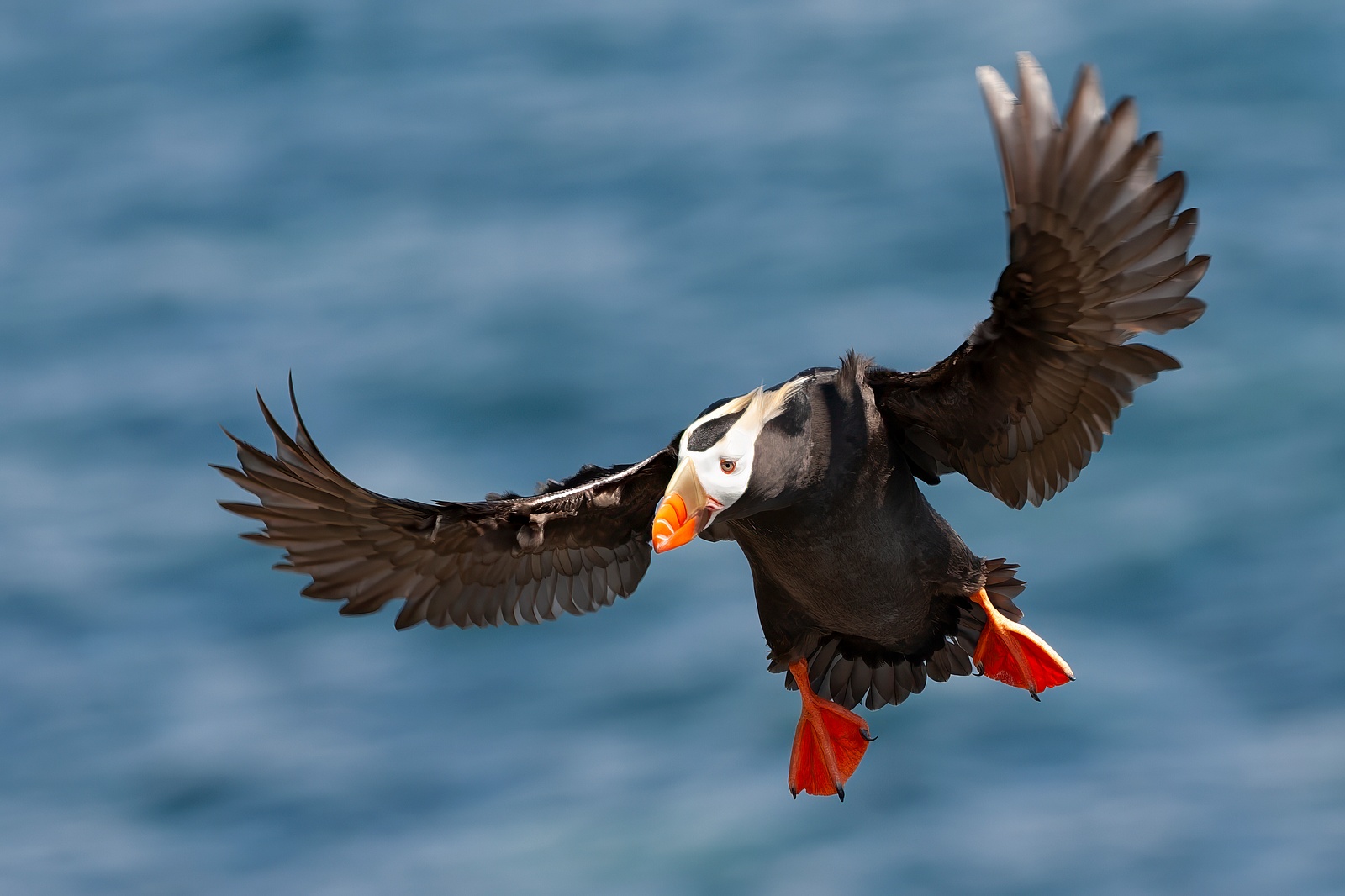 Tufted Puffin returning to cliff rocks after feeding offshore up to 60 miles.
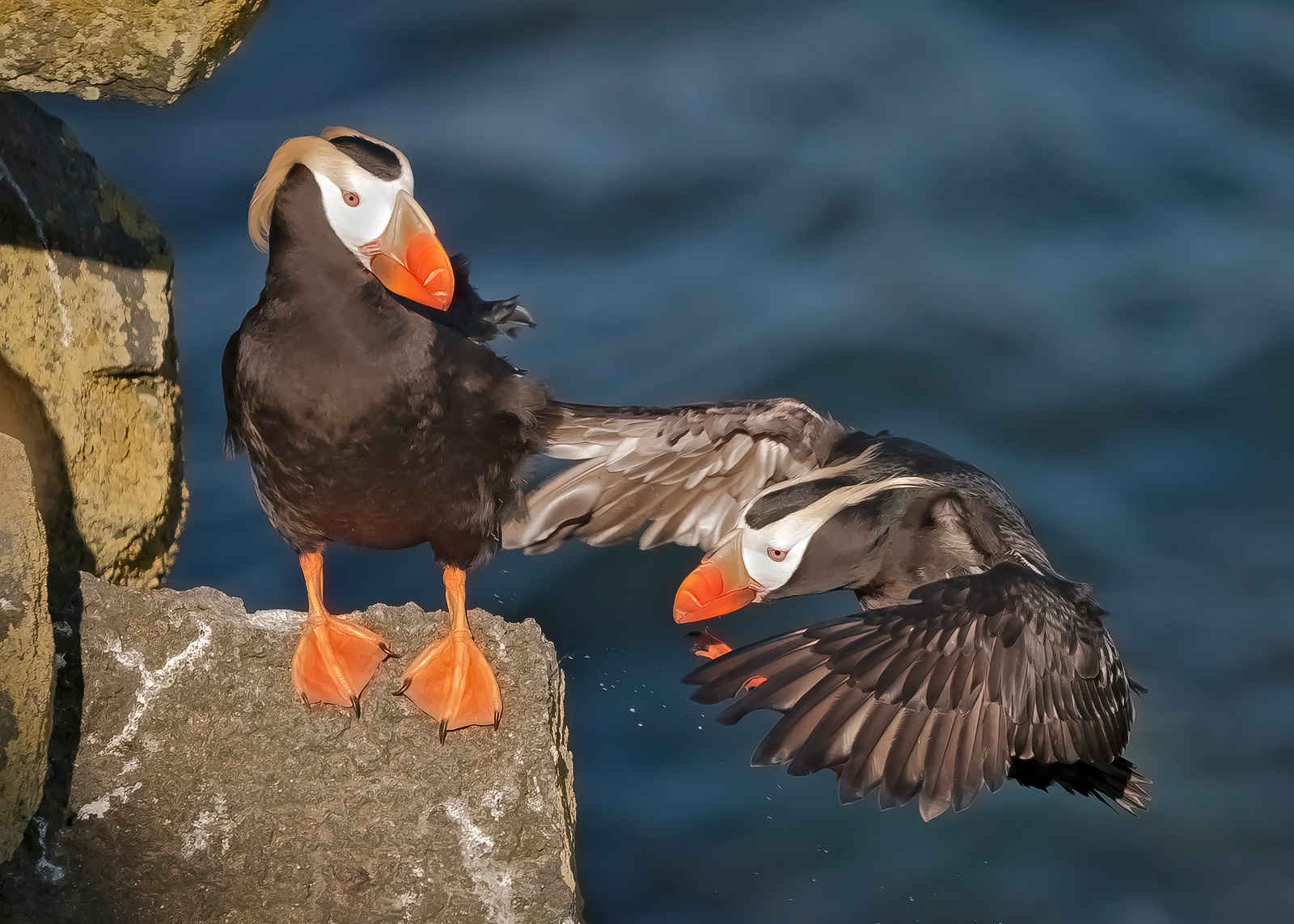
Above: Female Tuffted Puffin returning to Reef Point cliffs from foraging offshore. Landing on the shear rock faces with large orange feet is precarious.
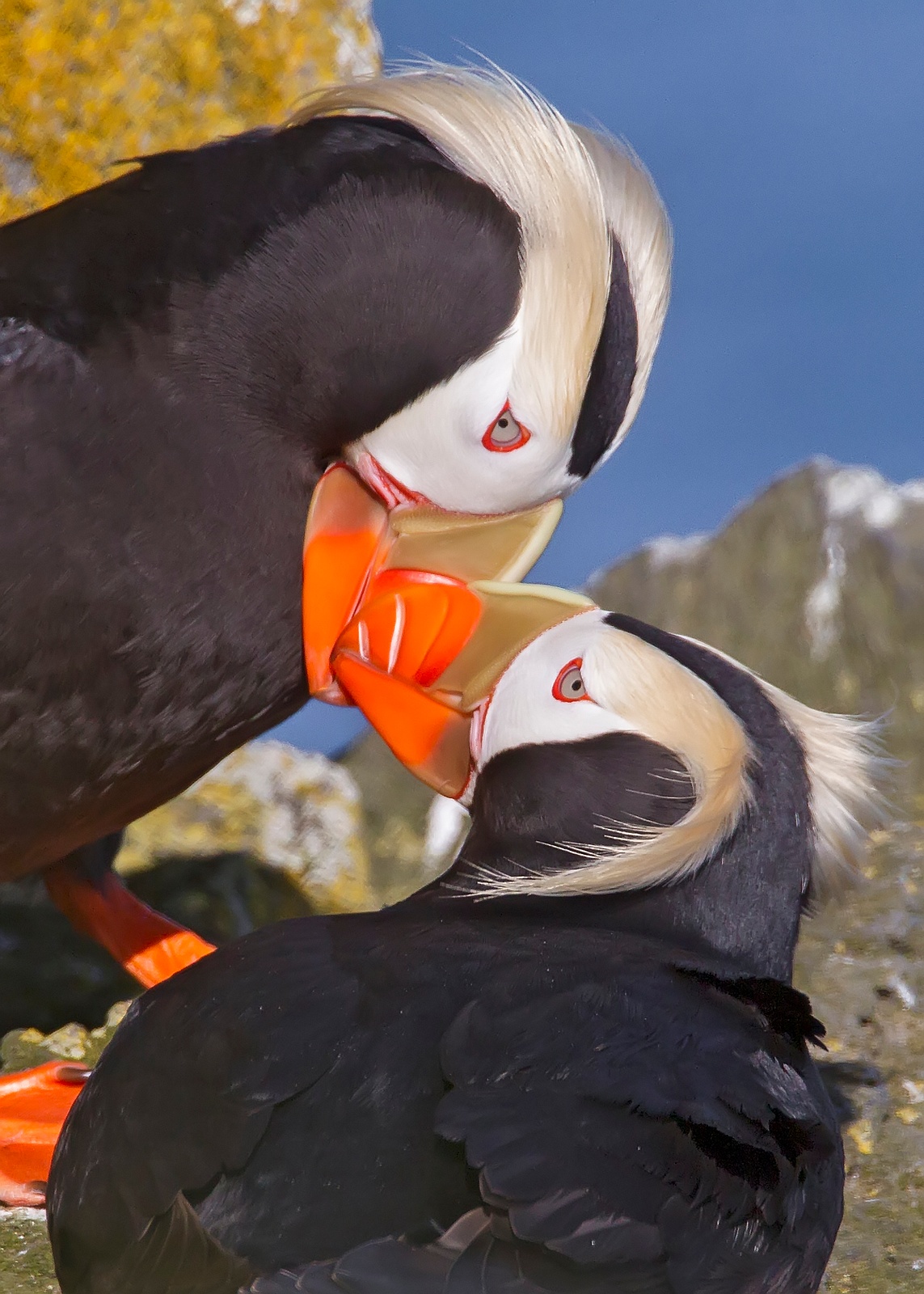
Above: Breeding pair greeting one another - pair-bond bill-knocking behavior. The noise of the knocking and their vocalizations is really loud!
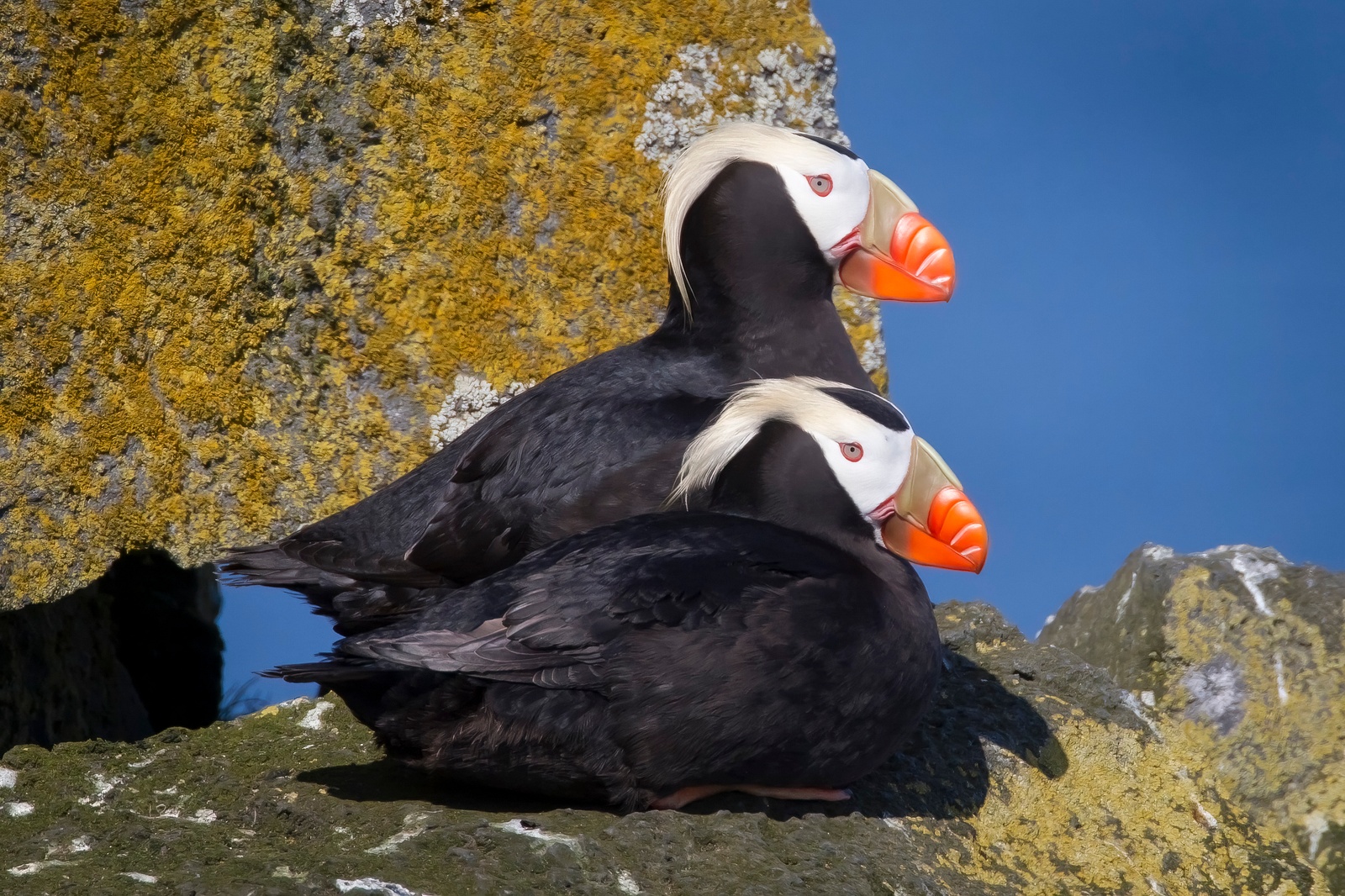
Breeding pair setting down near burrow nest to watch their world go by.
🕊️🕊️🕊️
Auklets
25 species (living and extinct) of Auklets occur worldwide. They are closely related to Puffins - both in the same family - the Alcidae. One species - the Rhinoceros Auklet seen in lower photograph has been found to be more closely related genetically to Puffins than to other Auklets.
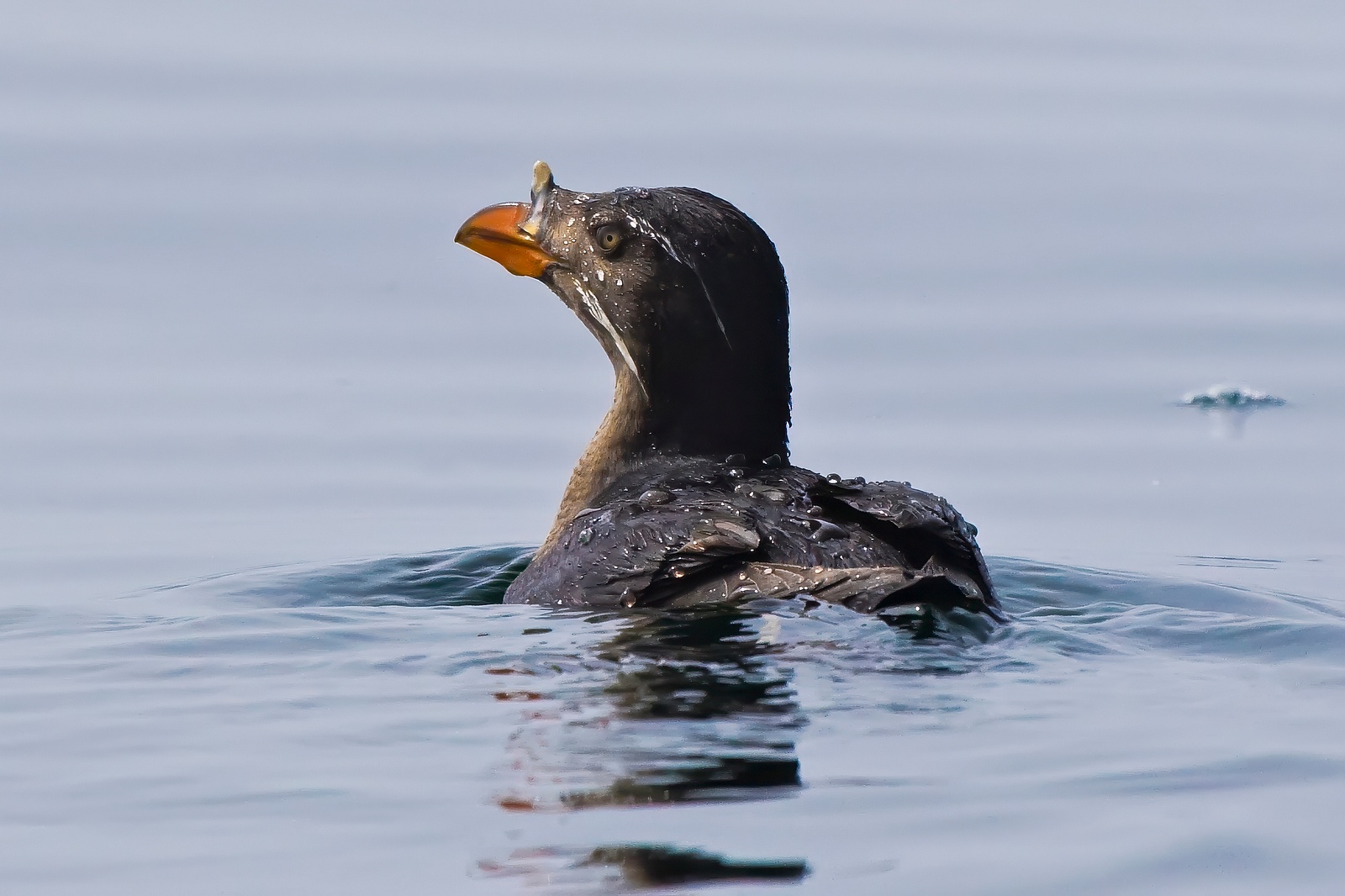 Rhinoceros Auklet (Cerohinca monocerata) . This species is the largest North American Auklet. They are usually solitary except when breeding. The "horn" on upper bill grows each spring and is shed in the fall. This species is rarely seen along the shores of St. Paul Island. We saw two individuals but neither was photographable. This one was photographed by the author in SW Alaska (Prince of Wales Island, Alaska).
Crested Auklets (Aethia cristatella) 20-30 nesting pairs were observed and photographed along Reef Point. They are gregarious and breed in noisy colonies on remote islands and headlands in the north Pacific and Bering Sea. They spend the 9 month non-breeding season in the open ocean, often forming very large rafts of birds. In breeding plumage shown in the following photographs, they have a slate gray body overall, a stubby orange bill that upturned at the hinges giving the birds a comical appearance, a white stripe behind the white eye, and their distinctive head crest. 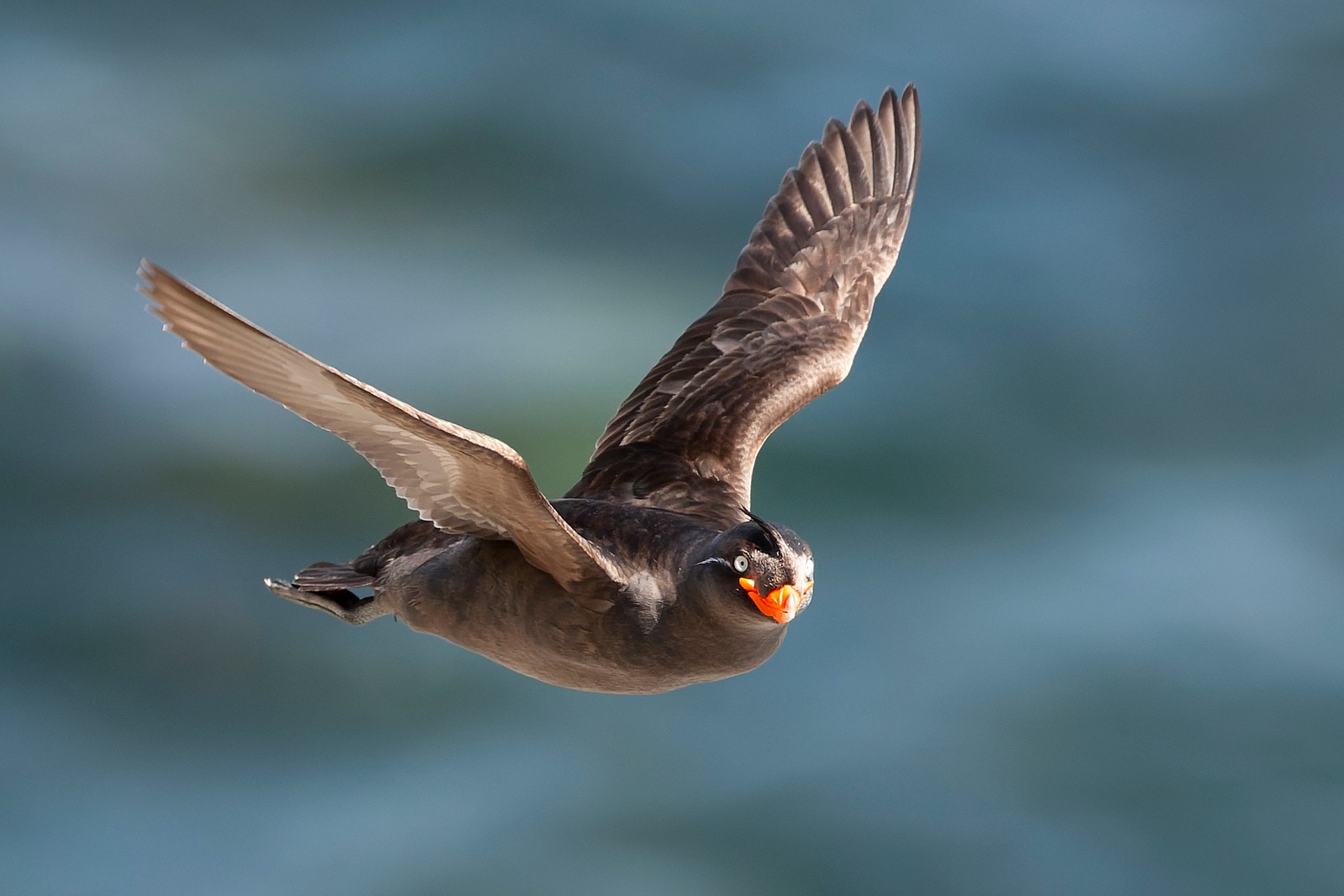 Crested Auklet: Flying past Reef Point heading to its nest burrow.
 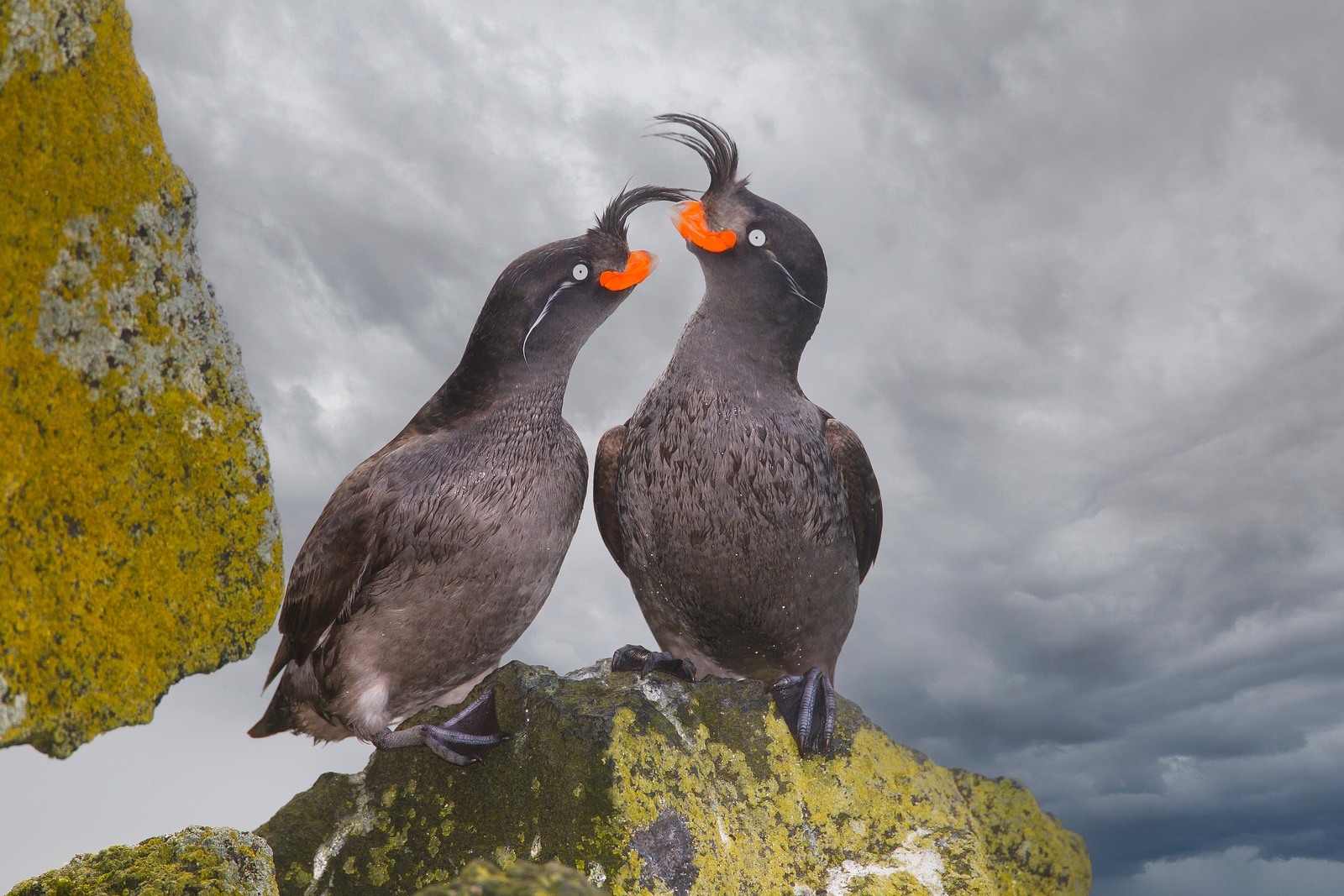 Crested Auklet nesting pair on Reef Point cliff boulders. Pairs are monogamous. When they return to their nesting area they check each other out thoroughly before they commit. They have an eleborate mating display where the male (right individual above- larger hook on billl tip) puffs out his chest, stretches neck and shrinks his pupil to enlarge the attractive white of his eyes. Both emite a lemon/orange/tangerine odor from oil produced at the base of specialized feathers. This compound (cis-4 decenal and octanal) and the length of the crest feathers factor in positively in mate selection.
The pair often nests close to or in previous nests (crevices in rocks, renewed burrows). One egg is laid and both parents share incubation.. The male is a fiece protector of the nest, female and chick. Both parents feed the chick - returning from fishing with plankton and small fish in specialized throat pouches under it tongue. The juvenile leaves the nest, jumping off the cliff for its first swim. It will leave the land and not return until spring of its 3rd year when it is ready to find his own forever mate.
🕊️🕊️🕊️
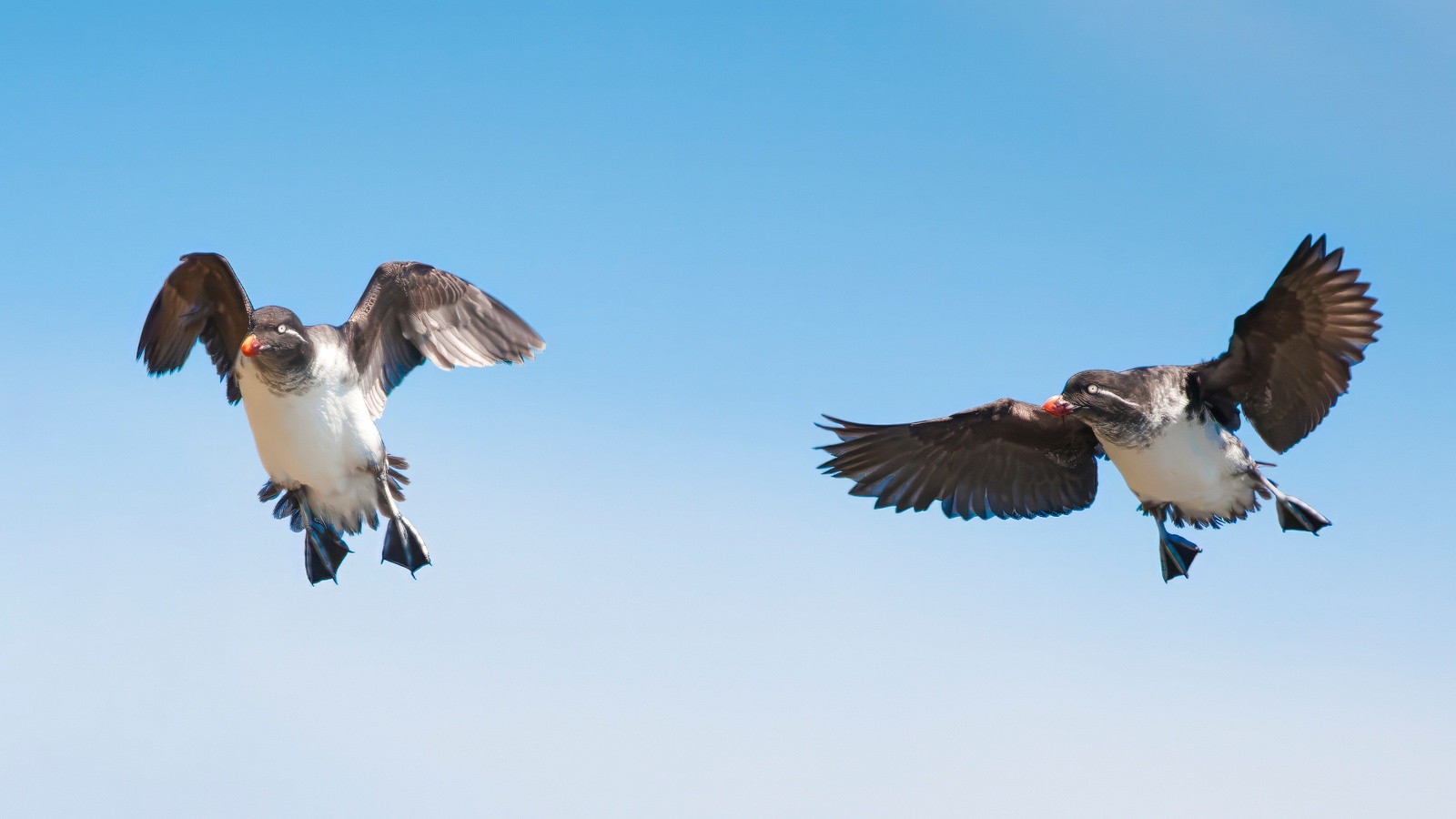
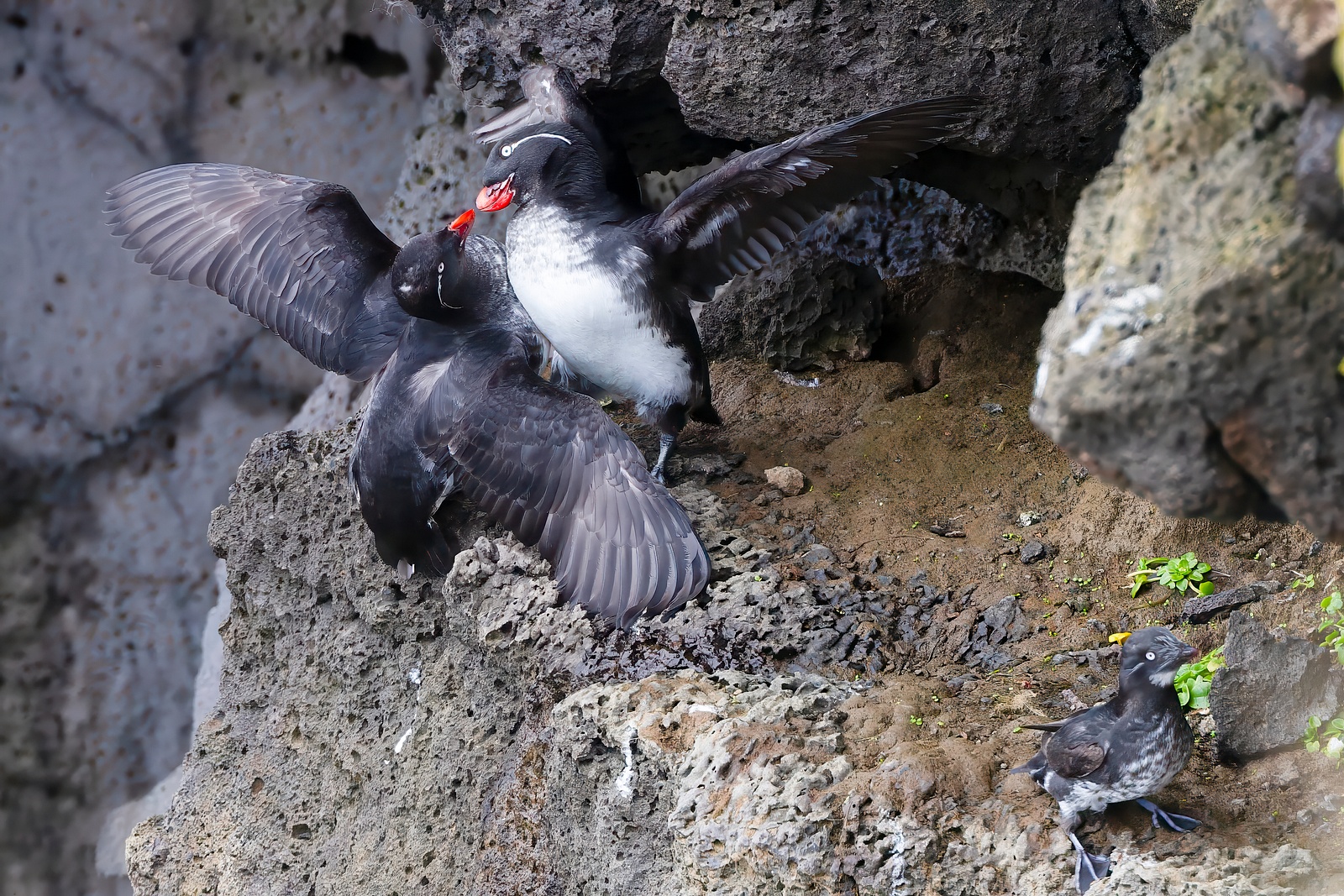
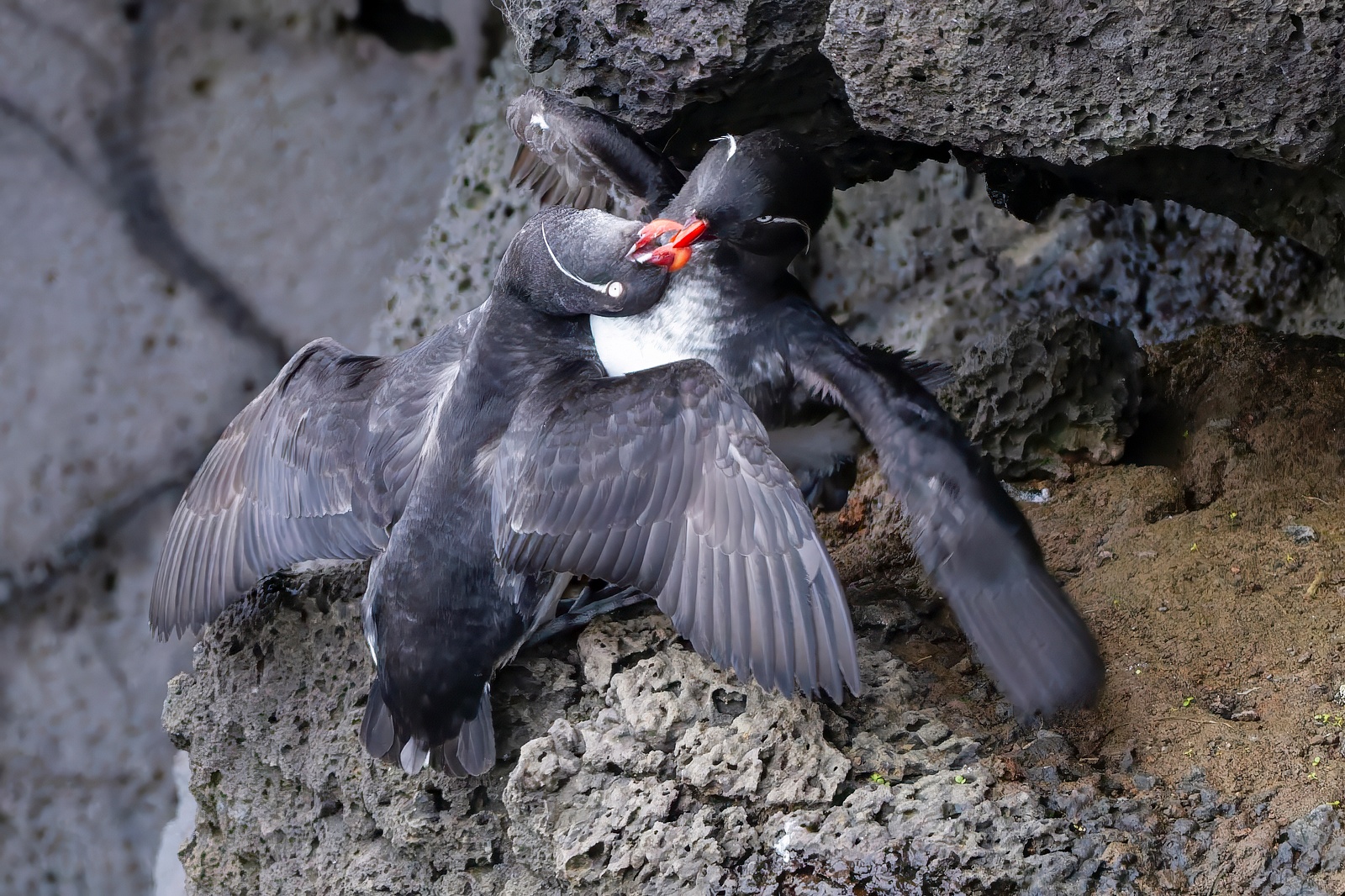
Parakeet Auklets (Aethia psittacula) are not as frequently seen as other Auklets on St. Paul Island. They are small-size and when breeding have pale eyes, two whispy white feather plums behind their eye and an unusual bright orange bill that is somewhat circular in profile . The upper mandible is strongly convex in shape and has a very sharp edge. The lower mandible has a sharply upcurved shape. These modifications assist them in capturing their favorite jellyfish and ctenophore prey. They have the widest geographic range of all the Alaskan auklets, through the Gulf of Alaska and Bering sea and north Pacific, south of the Aleutian Islands and the Sea of Okhotsk. They nest in burrows or in cracks of large boulders along steep rocky areas. One egg is laid per season and both parents incubate this egg. The chick can forage soon after hatching. Parents deliver food to the nest vicinity that the chick eats. It leaves the nest about 5 weeks after hatching and swims off to the open ocean where it will spend its first 2+ years before returning to its place of birth to breed.
We found several pairs of pairs among the cliff boulders of Reef Point. All were paired up and we were able to watch pair-bonding behaviors, flying and nest site protection fights among other individuals. 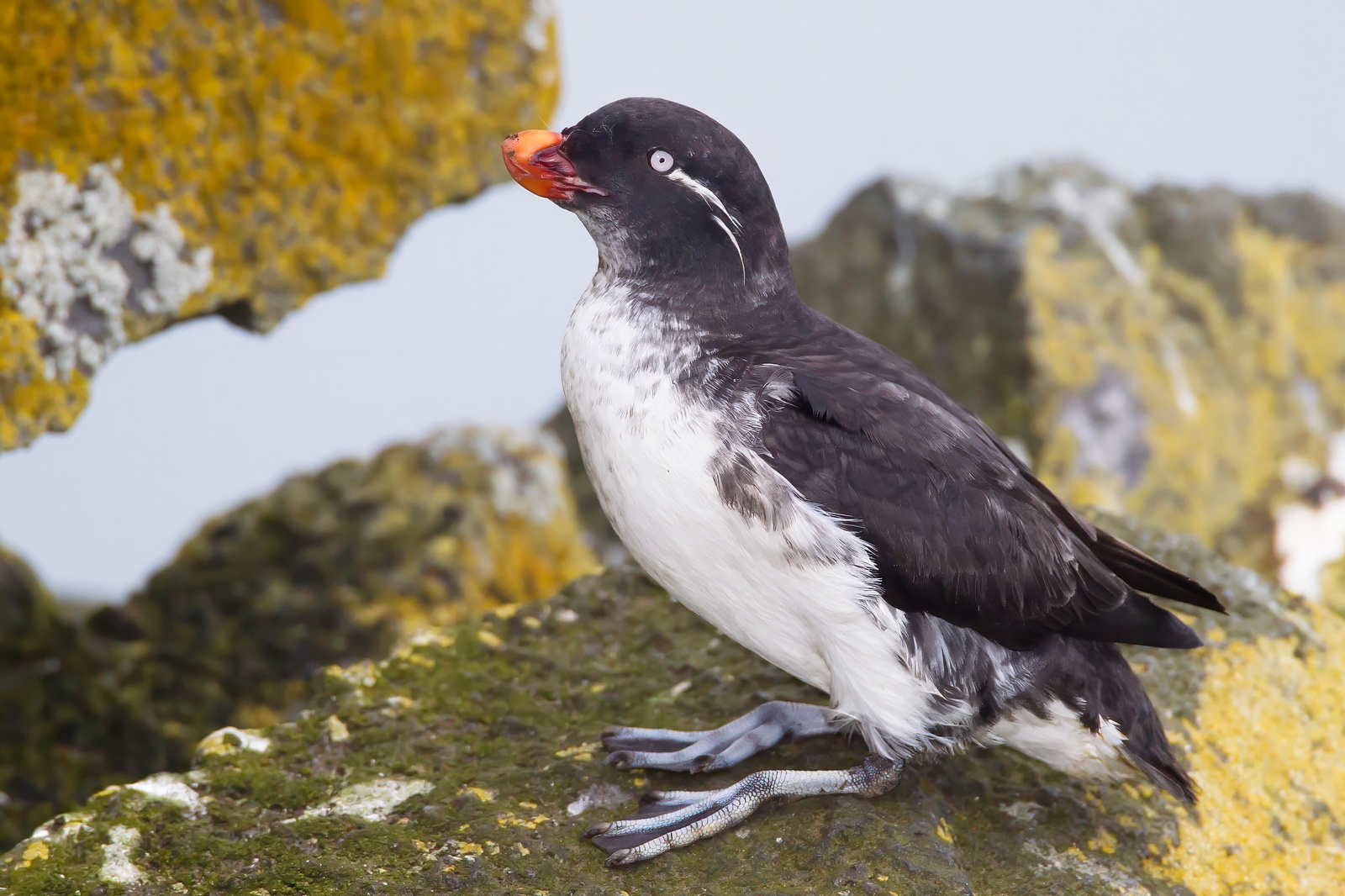
Above and below photographs of two individuals resting adjacent to their nest sites in the cracks of large boulders at Reef Point.
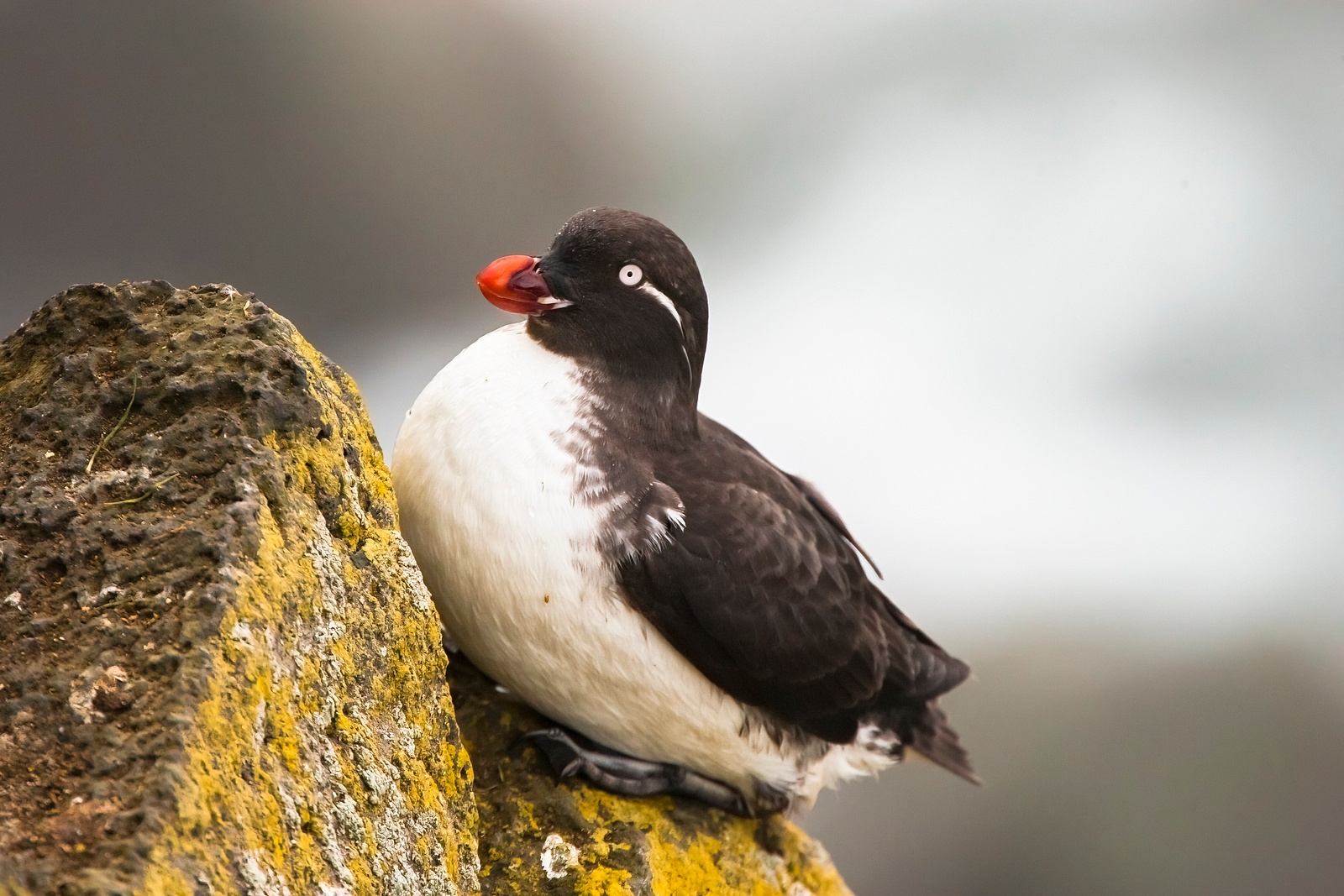
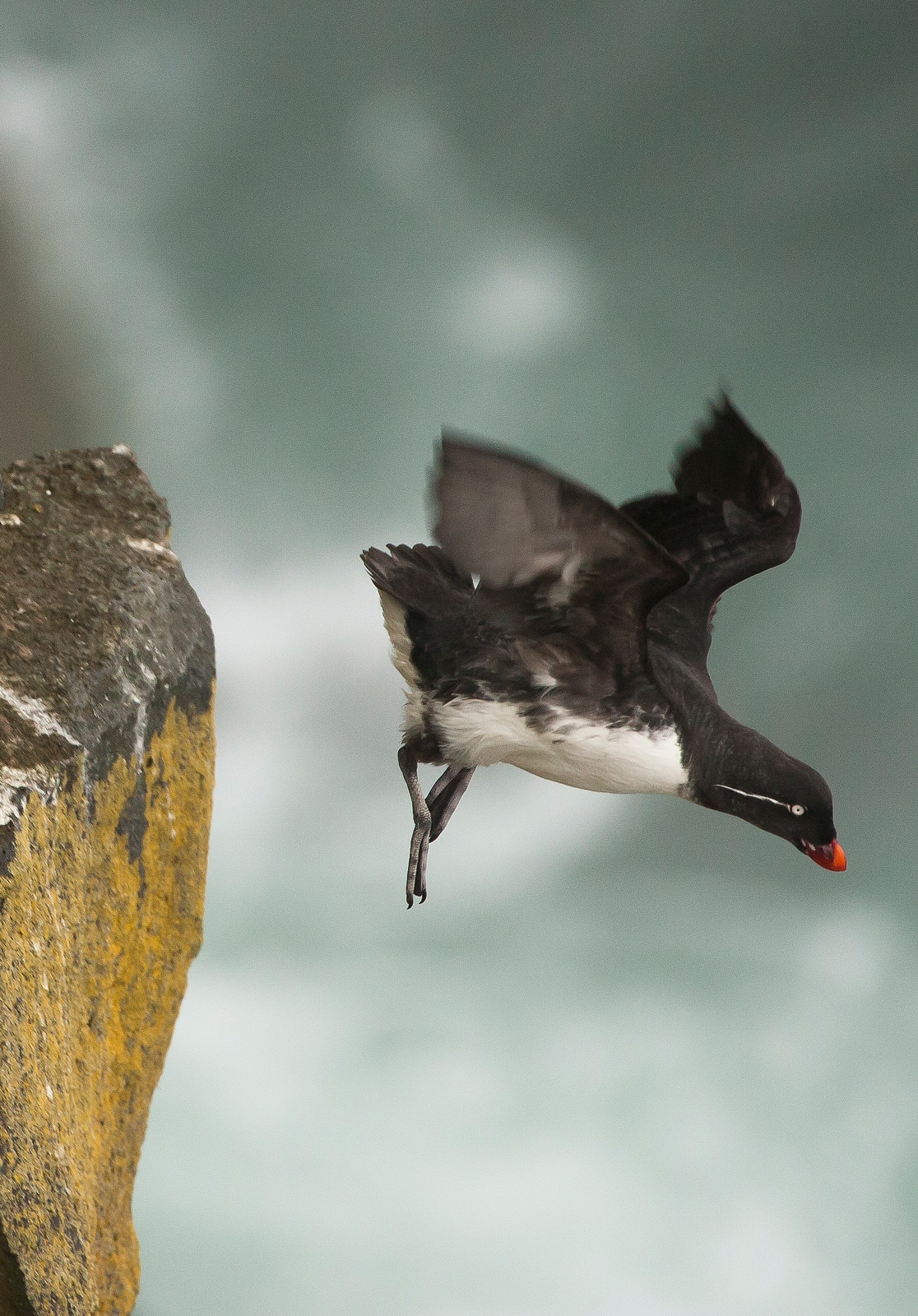
Above and below - taking flight. Upper the individual has just jumped off its nest rock, and heads out to sea to feed. Below - a pair is returning to their nest after feeding.
In the lower photographs, one of the residents of the nest burrow (dark hole to right of defending bird behind the nest brown excavation debrise) is fighting off an agressive interloper set on taking over this nest site. The smaller birdi in the right corner is a Least Auklet.
🕊️🕊️🕊️
Least Auklet (Aethia pusilla). The highly social Least Auklet is the smallest of all Auklets, about the size of a sparrow - 6" and 3 ounces. It is the most abundant seabird in the North Pacific with an estimated 10 million birds. They nest in crevices and burrows along rocky cliff and are very abundant nesters in islands of the Bering Sea. 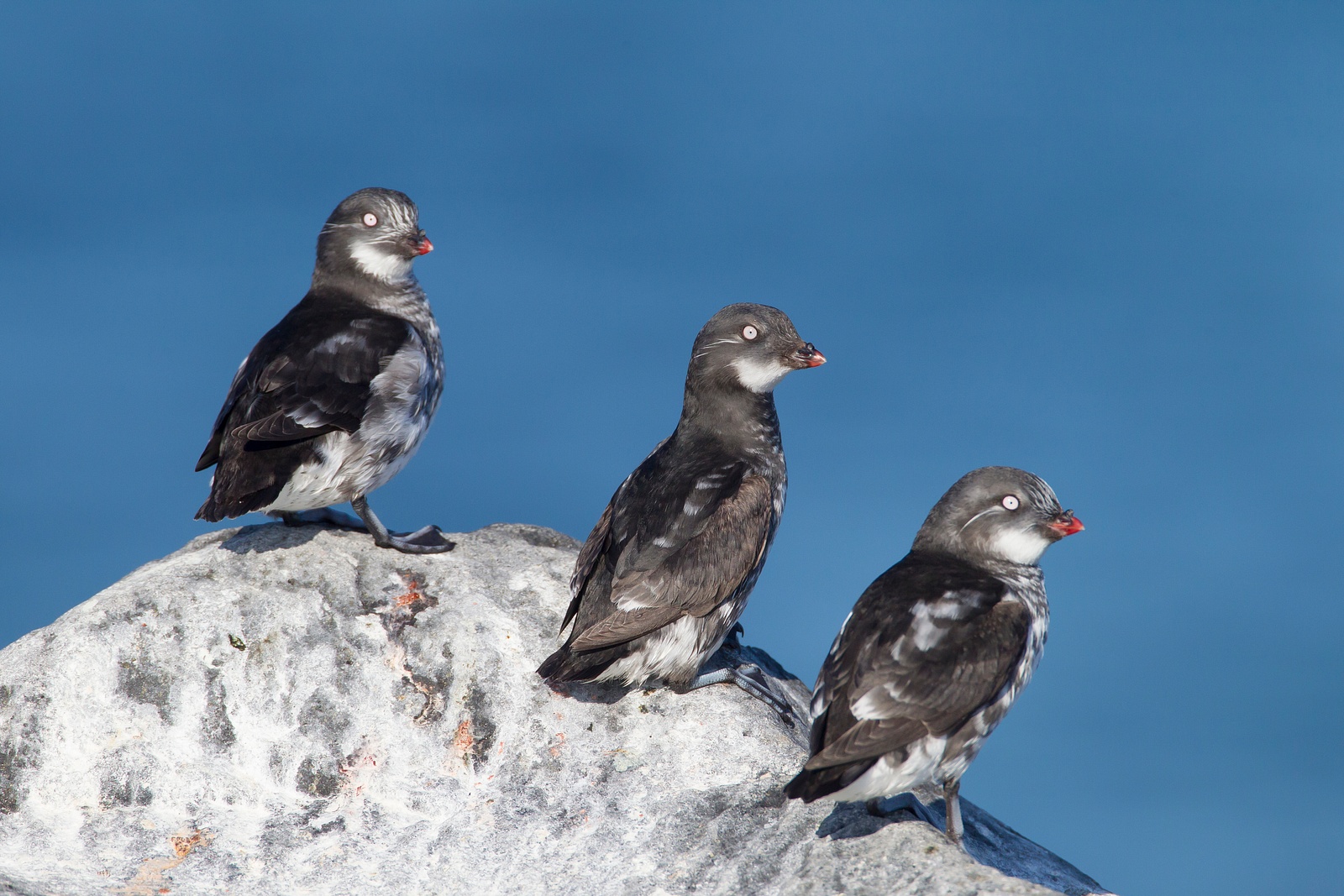
They are gregarious, frequently seen in groups of 3 -30 individuals, crowded on the surface of bolders at the lower part of cliffs. Unlike other auklets these birds are highly vocal - with a high, chirping trill call. In breeding plummage seen in these photograph, their lower breast and belly feathers are speckled and they have a white scapular band of feathers.
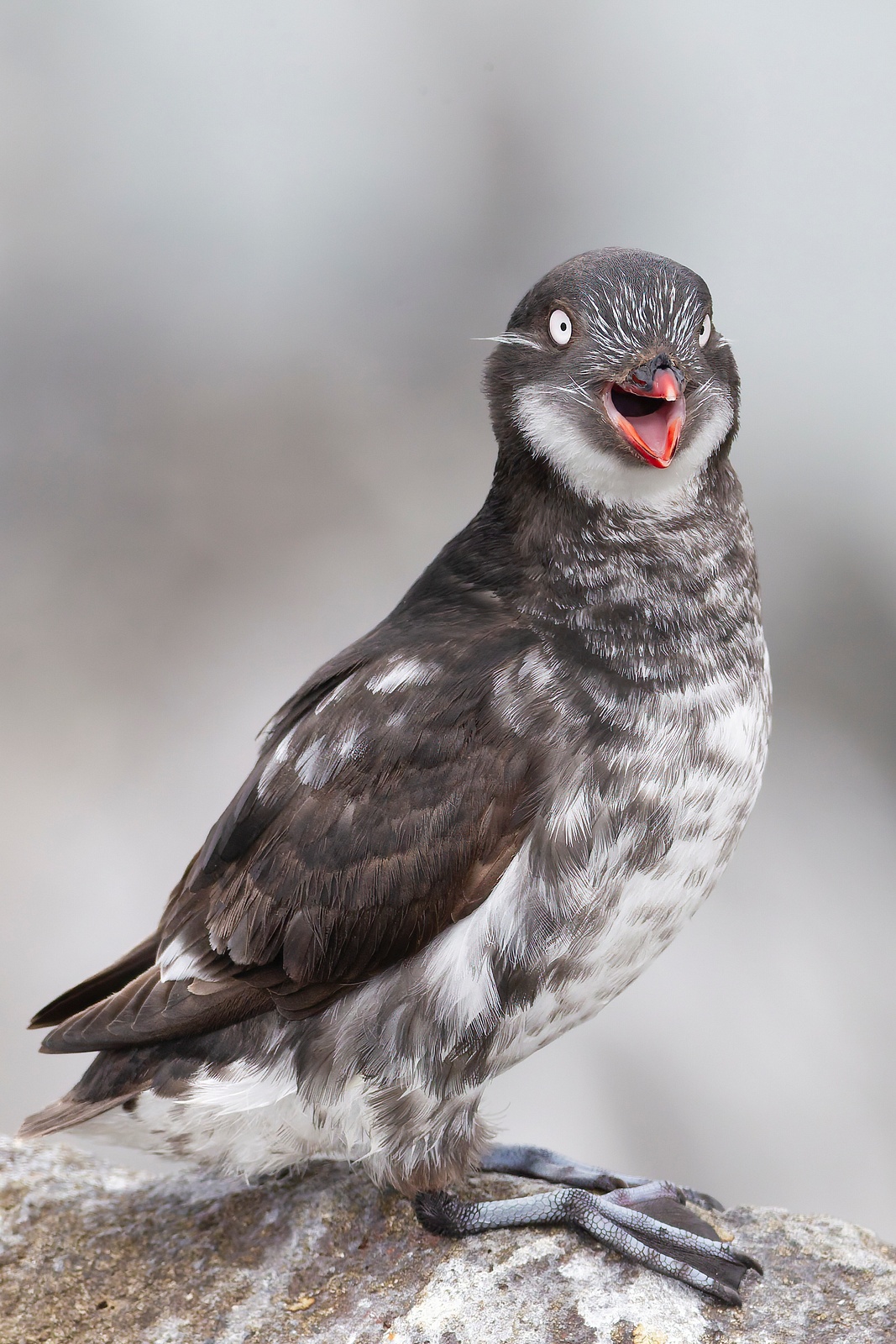
Their bright orange bill is adorned on the upper mandible by a protruberance similar to that of the Rhinoceros Auklet though much smaller. Males and females are monomorphic (similar appearance) and can be distinguised by the size of this protuberance which is larger in the male. The blue tarsus/toe scales seen in the above photograph are seen when breeding.
These little birds are very fast swimmers, using their short wings and large feet to propel them rapidly in pursuit of prey.. They feed on copepods, zooplanton, krill and pelagic snails and bring these back to their single chick in sublingual pouches. They eat nearly 90% of their weight per day and typically feed in upwelling areas and stratified thermoclines where prey can be clumped.
The pair nests in cliff rock crevices or in burrows. Both parents incubate, brood and feed the chick until it fledges. It enters it new world by diving off its home cliff - smimming out to deeper waters to feed. They will not return to land again for another 2+ years.
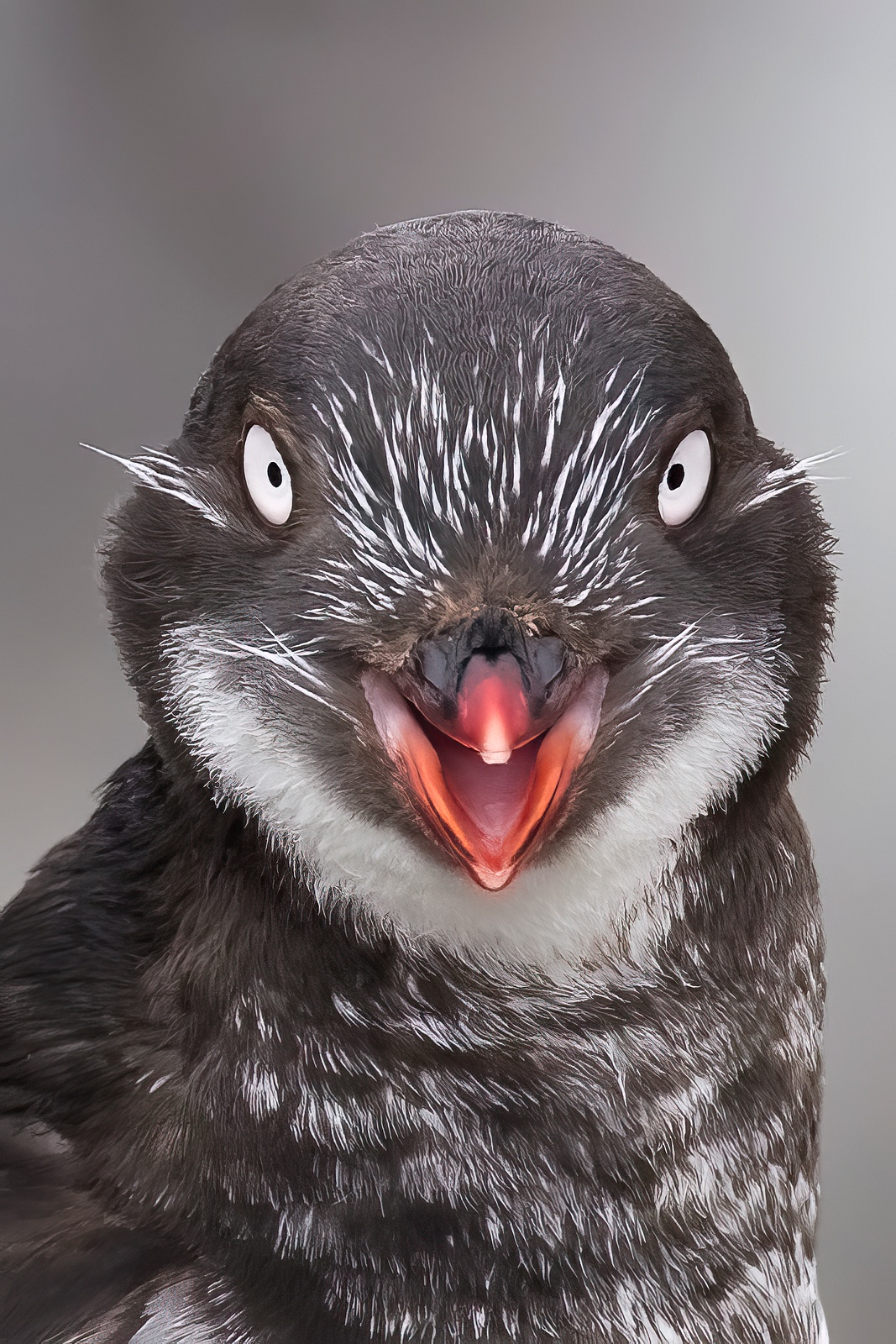 Here's lookin at you!
🕊️🕊️🕊️
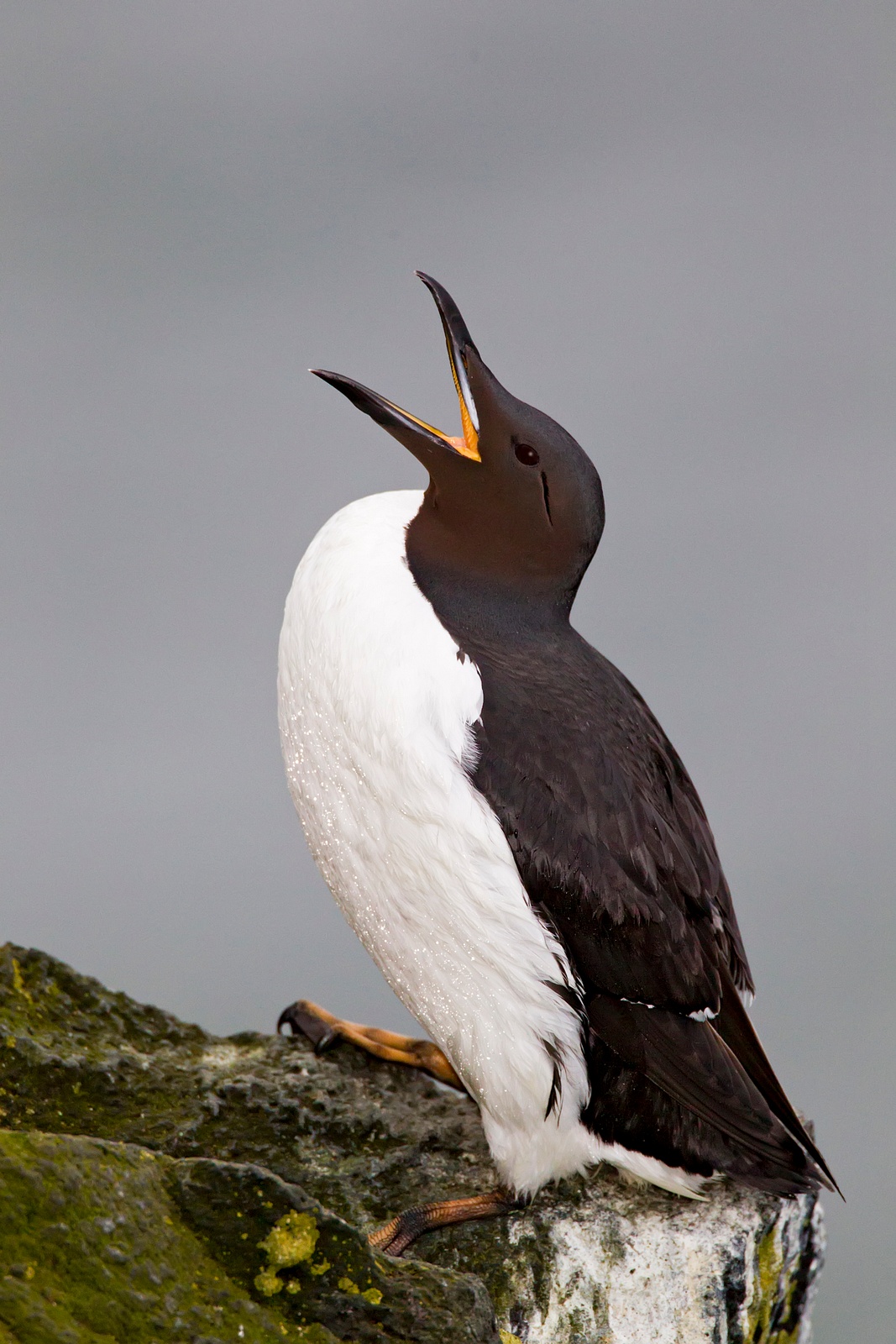
Thick-billed Murre (Uria lomvia), also known in Europe as Brünnich's Guillemot is a large (17") seabird of the Alcids (Alcidae) family that includes all the Auklets, Puffins, Guillemots, Murrelets, Razorbills and Dovekies. They breed in colonies along rocky cliffs and after being ashore for 2-3 months, they return to deep oceans over the continental shelf and slope of the North Pacific and North Atlantic oceans where they dive up to 650 feet in search of small fish. In these open ocean habitats, they remain in ice-free very cold waters of about 5 C degrees. They are very vulnerable to climate change as studies have shown dramatic population declines with 0.8 C increase in water temperatures.
This Murre was photographed in a large breeding colony along Ridge Wall on the southwest point of the island. A pair has the smallest territory of any bird - defending about one square foot of bare rock on which it lays a single egg and defends the egg aggressively. Both parents incubate the egg and care for the chick which after 18-25 days leaves the nest at nightfall and jumps off the cliff edge into the roiling waters. The parents immediately dive in next to the chick and the male will spend another 8 weeks at sea with the chick, providing it food.
🕊️🕊️🕊️
Other Nesting Seabirds of St. Paul Island
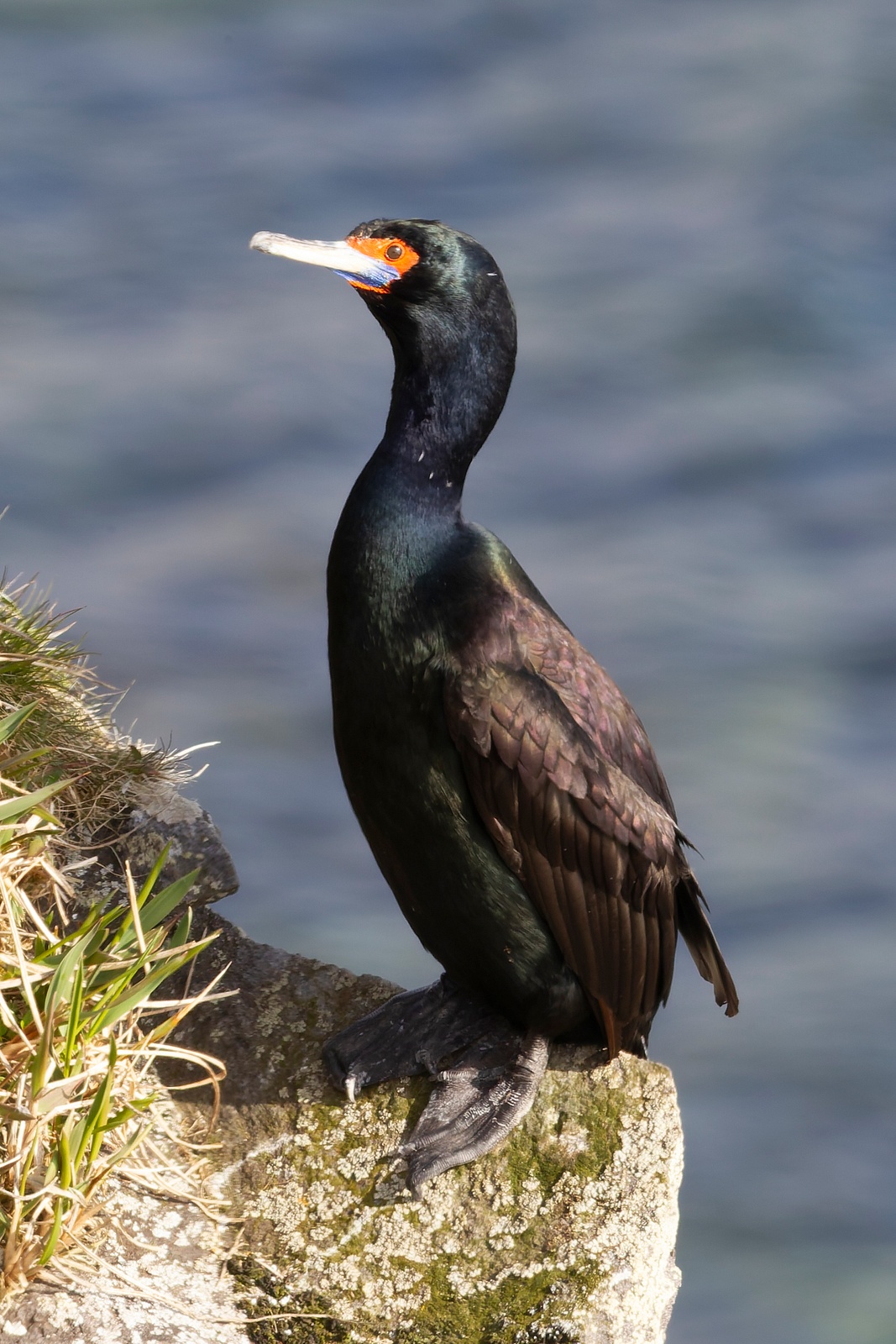
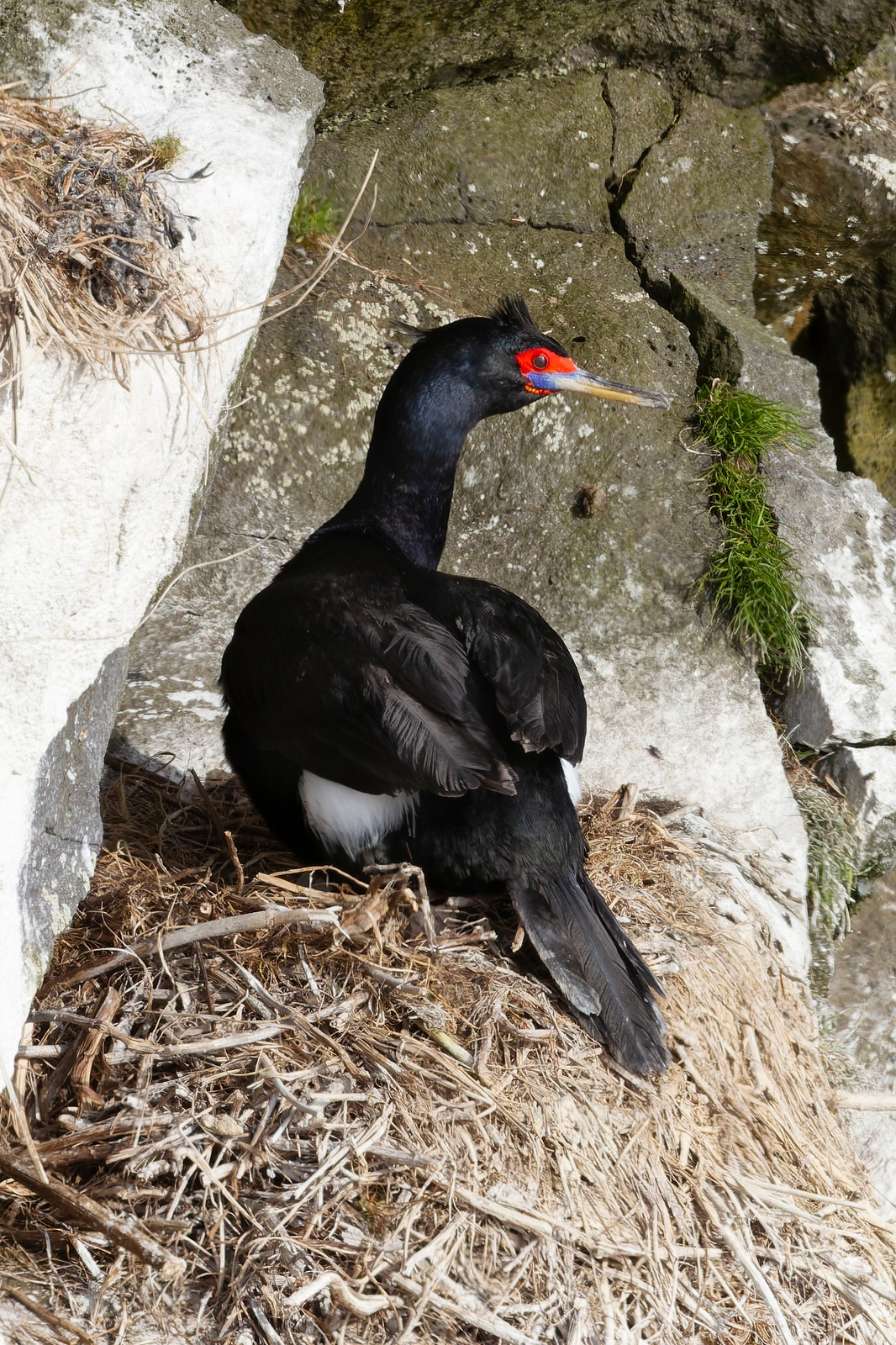
Red-faced Cormorants (Urile urile). These stunning cormorants nest along precarious steep cliffs in the Pribilof and Aleutian Isands and in east Asia. In breeding seasons they have cherry-red faces and yellowi lower bill mandible and beautifully irridescent body feathers. These birds (above and below) were on an extremely steep cliff and very difficult to photograph for an acrophobic photographer such as myself. These individuals were paired and one (lower) is sitting on a nest presumably incubating 2-3 eggs while the other (upper) stands on guard nest to nest. Upon hatching, both parents take care of the chicks for 40-50 days. The chicks do not leave the nest until a few days before fledging. Both parents continue to feed chicks for several weeks after fledging.
🕊️🕊️🕊️
Black-legged Kittiwake (Rissa tridactyla) is a small plump gull with black wingtips. Its distribution is circumpolar in the northern hemisphere. Over the last 30 years their population has plumeted and it is now classified as as an IUCN Red list "Vulnerable category." It breeds along rocky cliffs (lower photograph) of the far north Atlantic (Canada, Greenland) and Pacific (Alaska to Siberia), foraging for small fish, mainly at night, over open ocean waters.
These kittiwakes were building nests and mating along the steep cliffs of Ridge Wall. St. Paul Island is also the home for breeding Red-legged Kittiwakes however, I did not photograph these on this visit.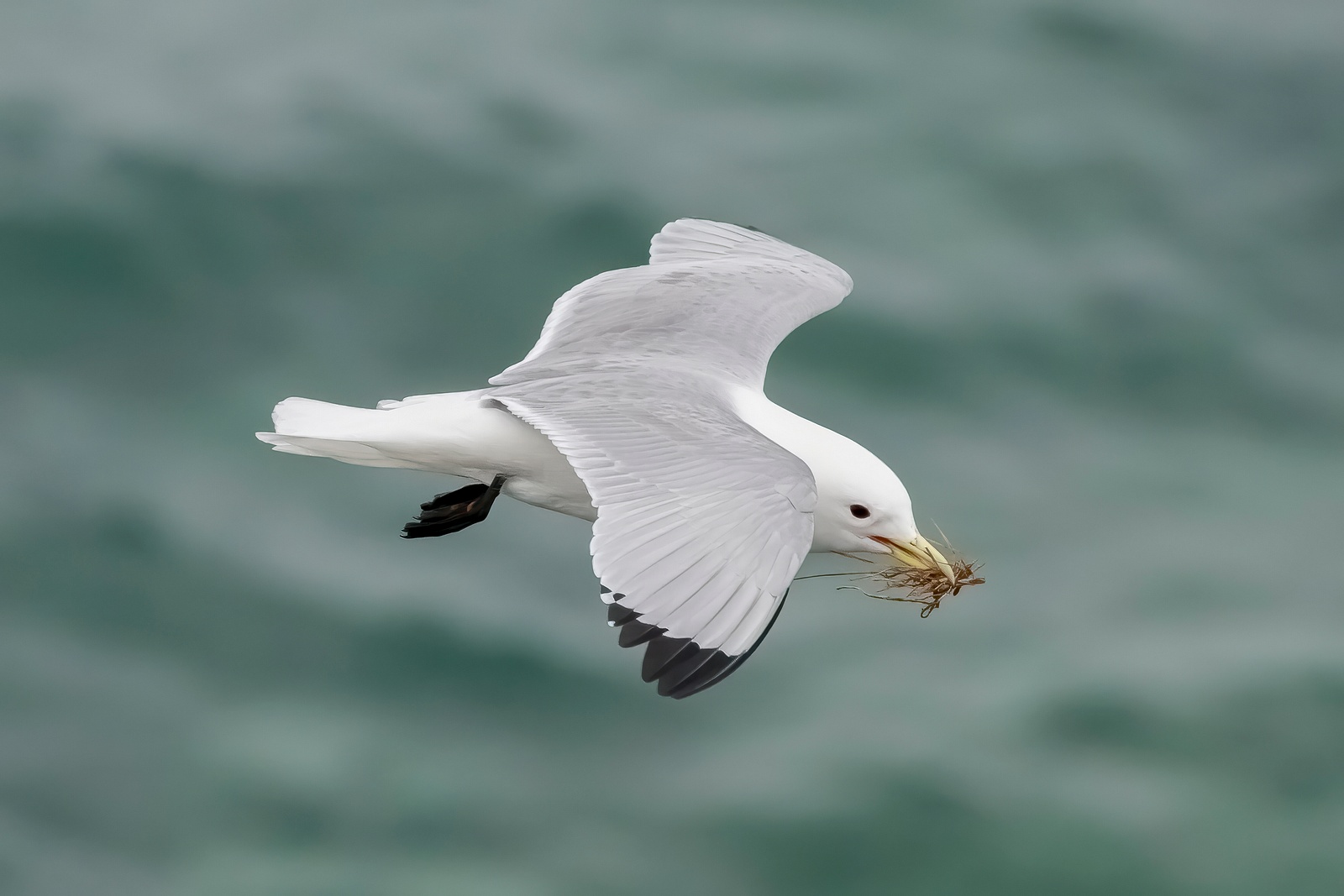 Above: Black-legged Kittiwake return to cliff nest with nesting material
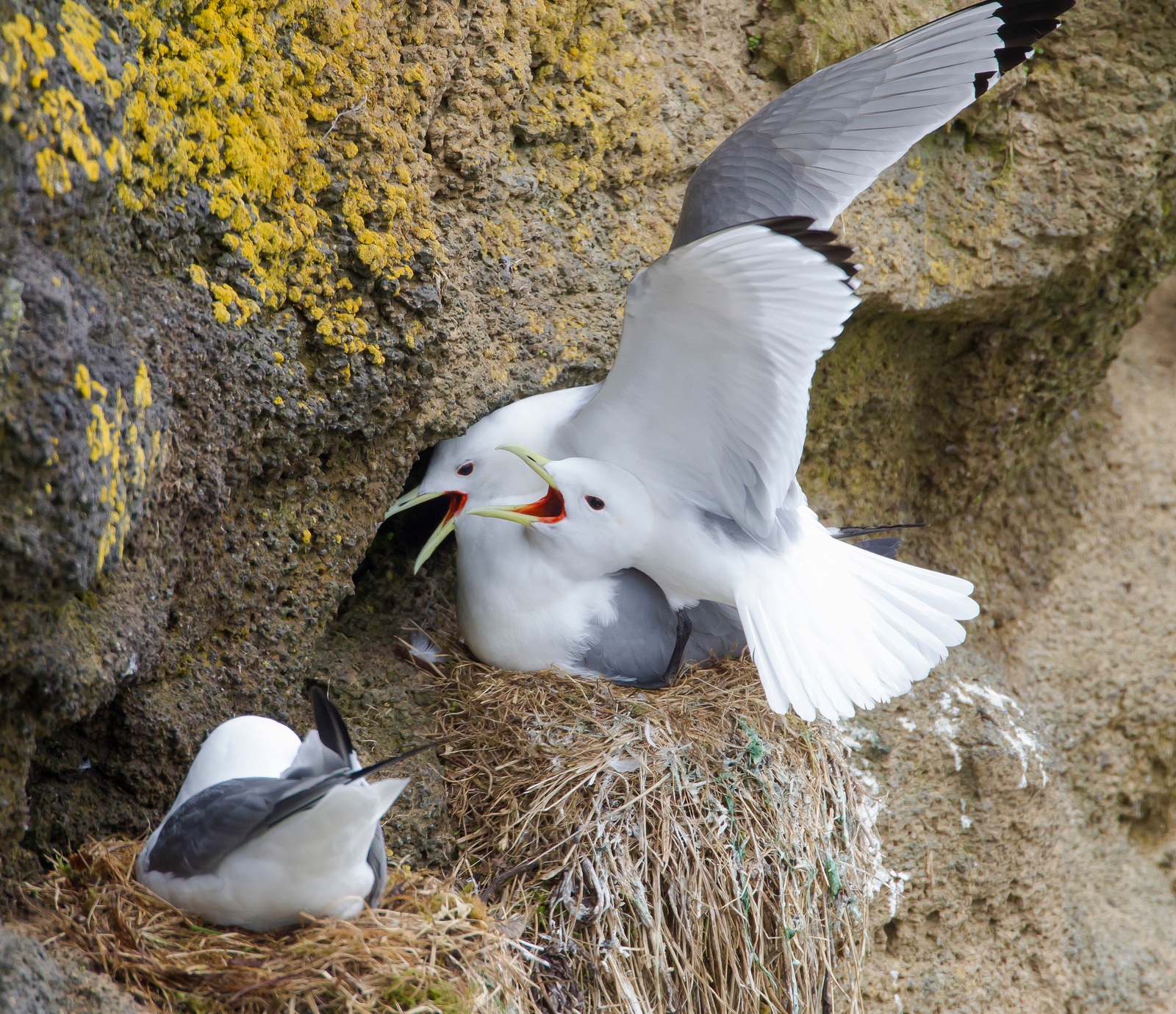 Male and female finishing mating and screaming at their incubating neighbor.
🕊️🕊️🕊️
Northern Fulmur (Fulmarius glacialis) is related to other Tubenoses - including Albatross, Petrels and Shearwater. They are found throughout cold-water open oceans flying great distances in pursuit of food. Like other Tubenoses, they have a powerful sense of smell, aiding in their search for fish, crustaceans and squid. They fly (below) with stiff singbeats in wheeling flights like shearwaters
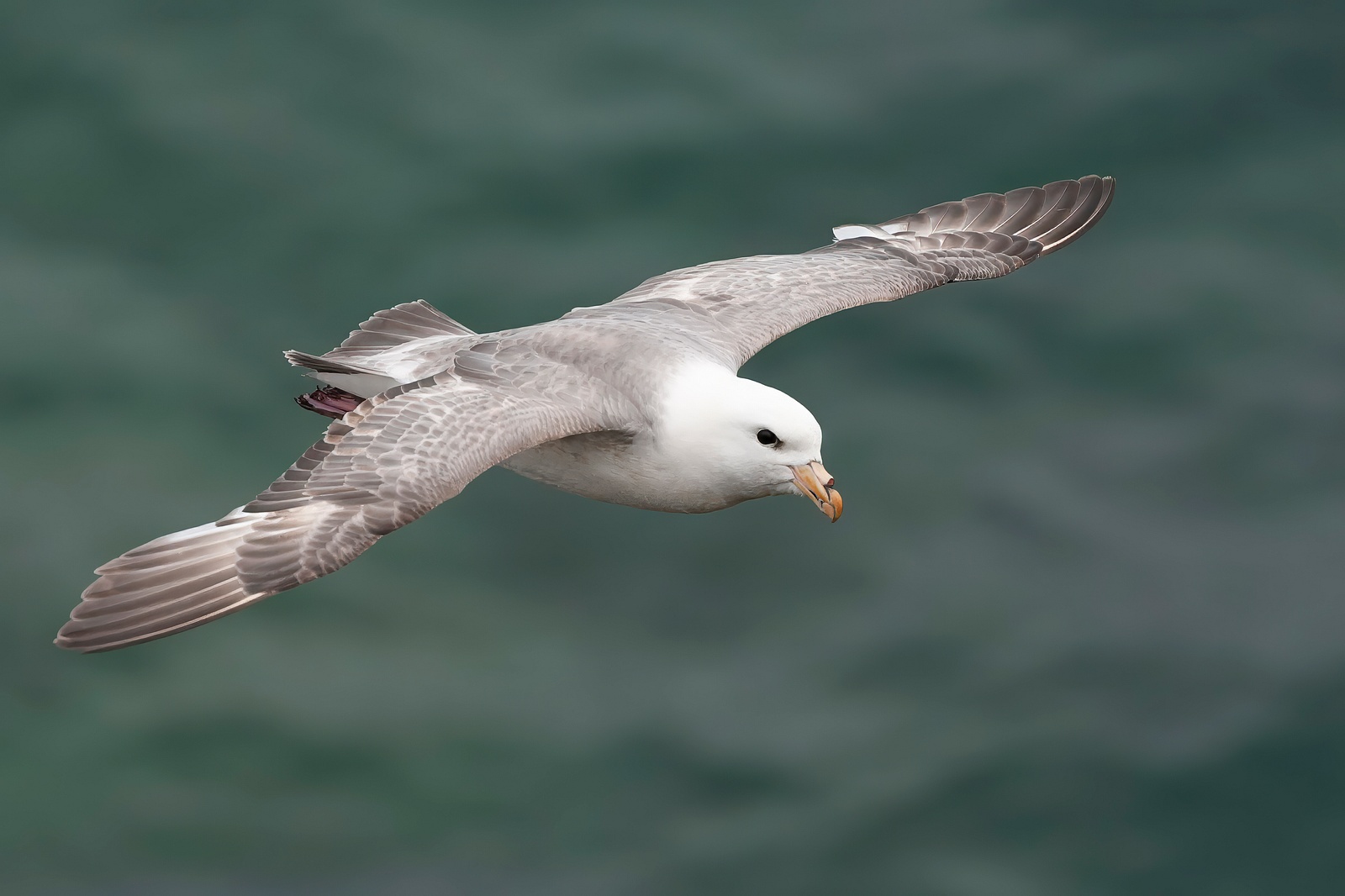
Below: Monogamous breeding pair of Northern Fulmur on narrow ledge on Ridge Wall. These are late breeders and do not return to their island cliffs to breed until they are 8-10 years old. Breeding behavior involves the female landing on the ledge and the male lands next to her and opens his bill and bobs his head while vocalizing loudly. These two had just completed that behavior and their mating and seemed to be enjoying each other's company. They will produce a single egg laid directly on the rock, and both incubate and care for the chick for nearly 100 days. 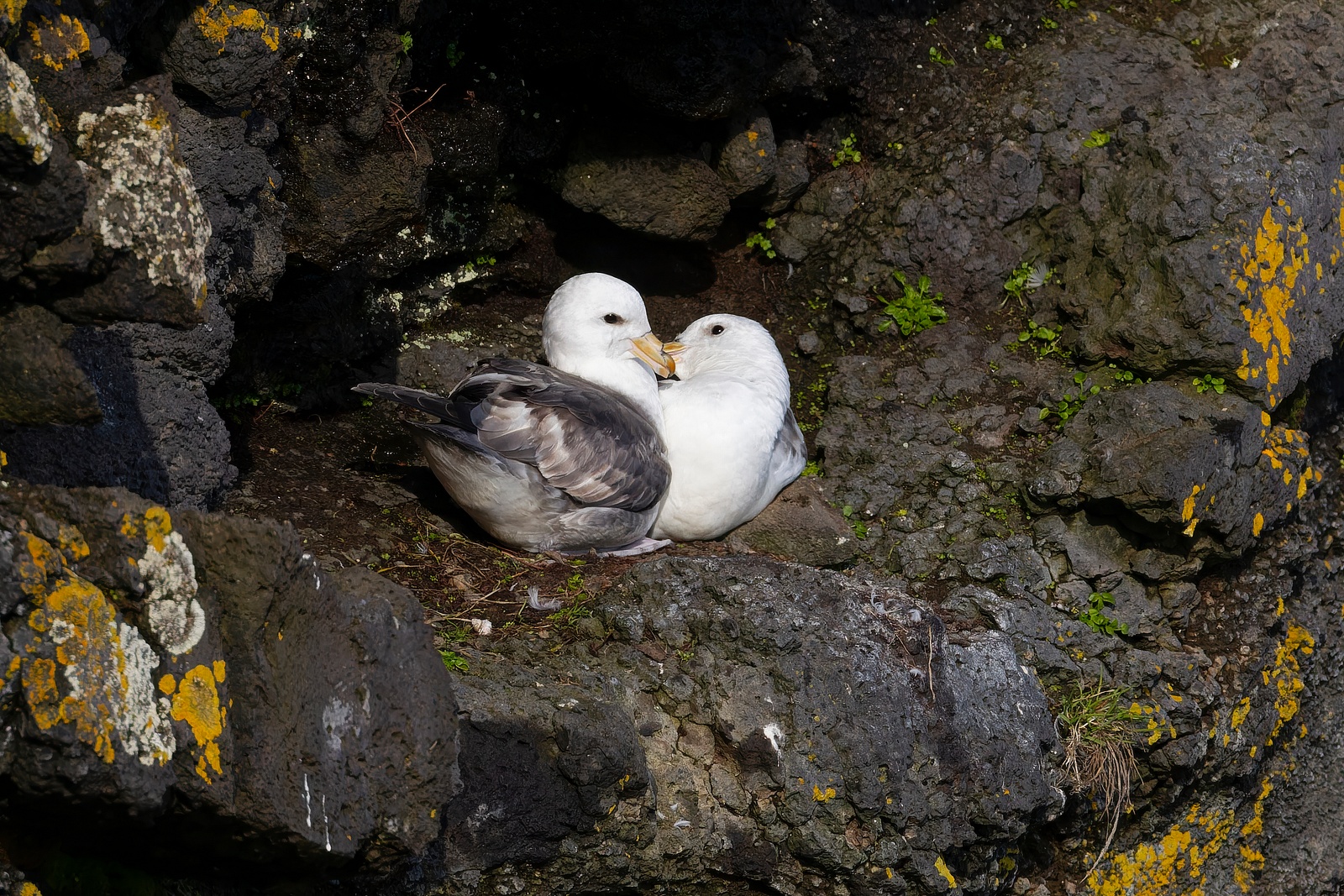
🕊️🕊️🕊️
A Few Other Birds of St. Paul Island
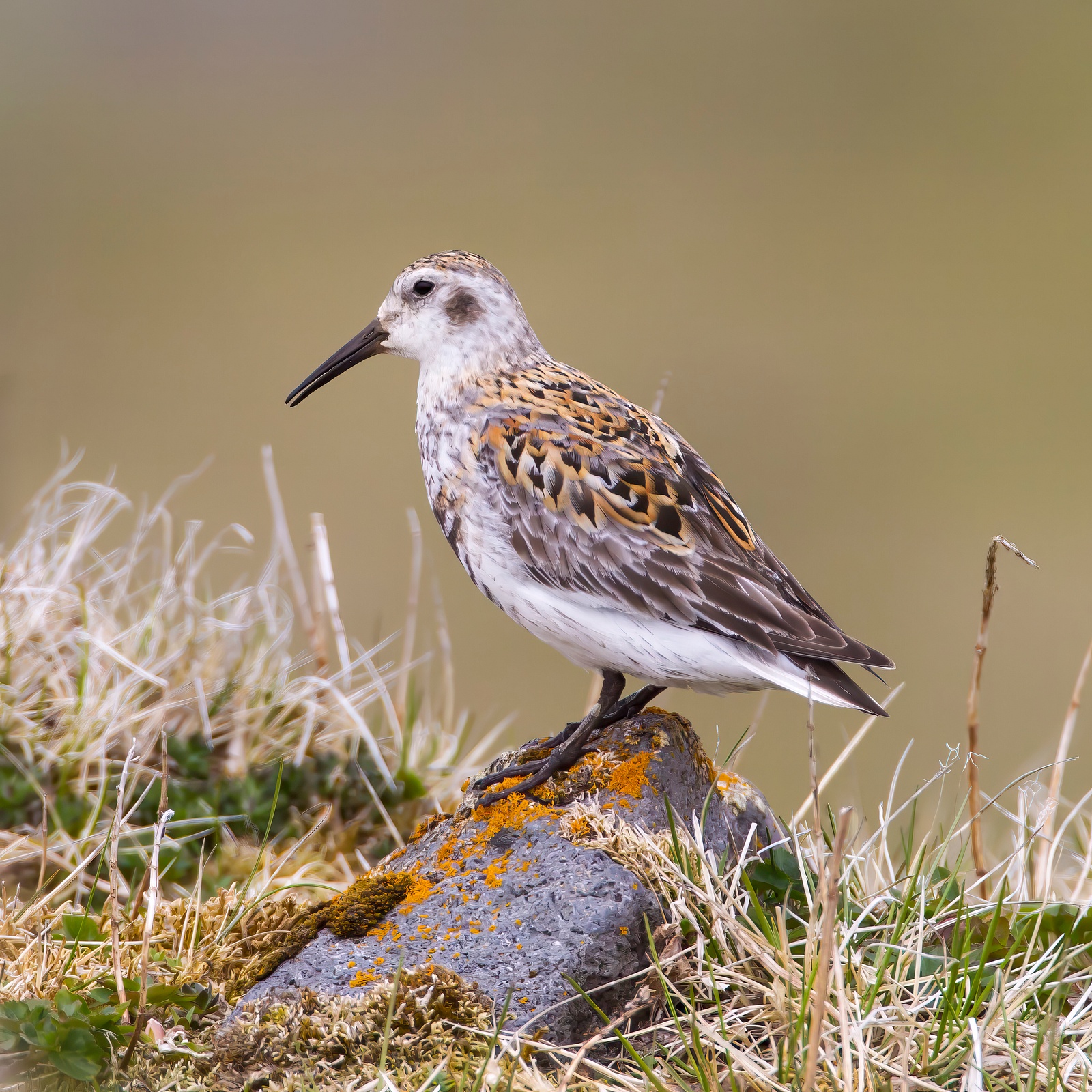 Rock Sandpiper (Callidris ptilocnemis) photographed in upland Tundra near Northeast point.
🕊️🕊️🕊️
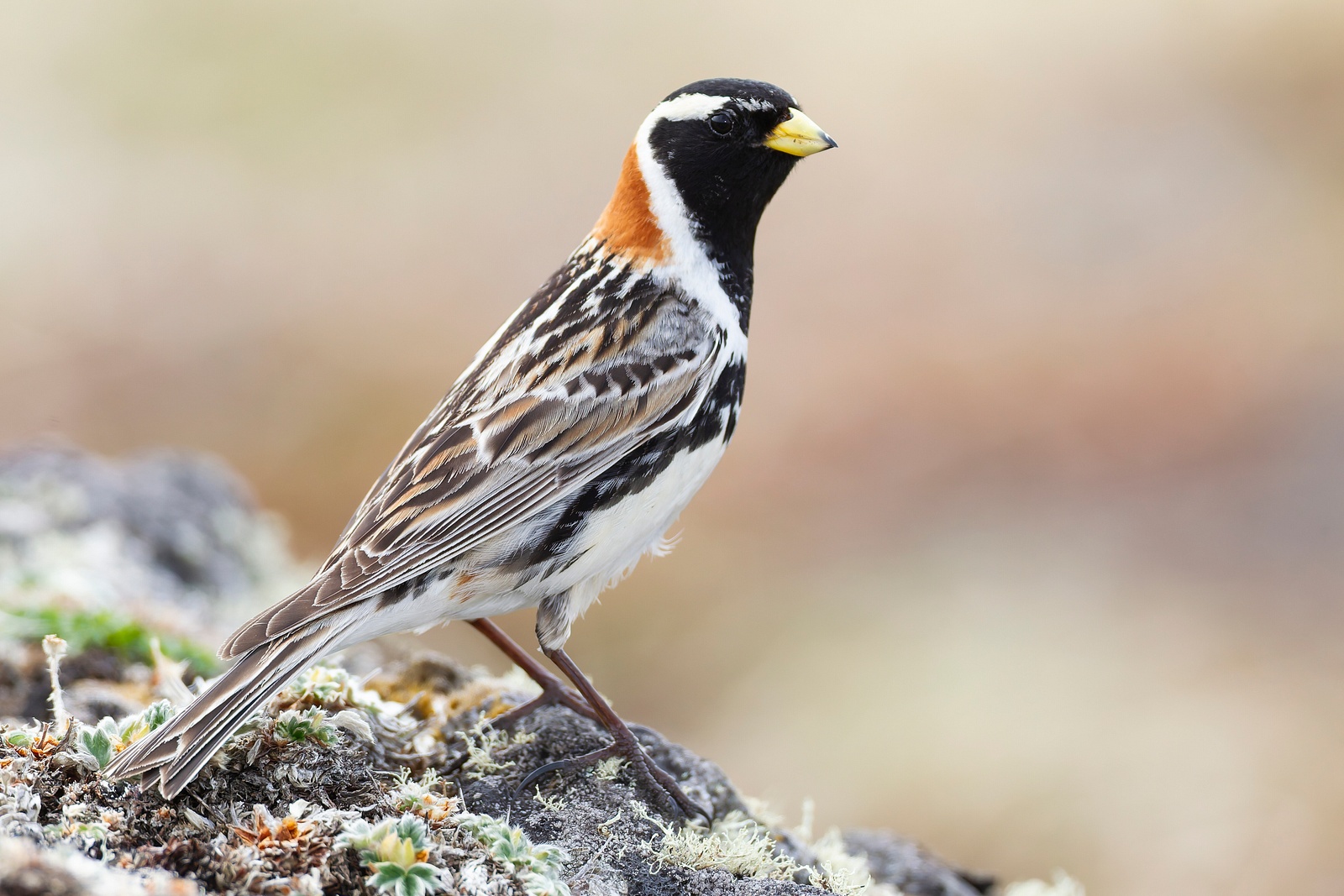
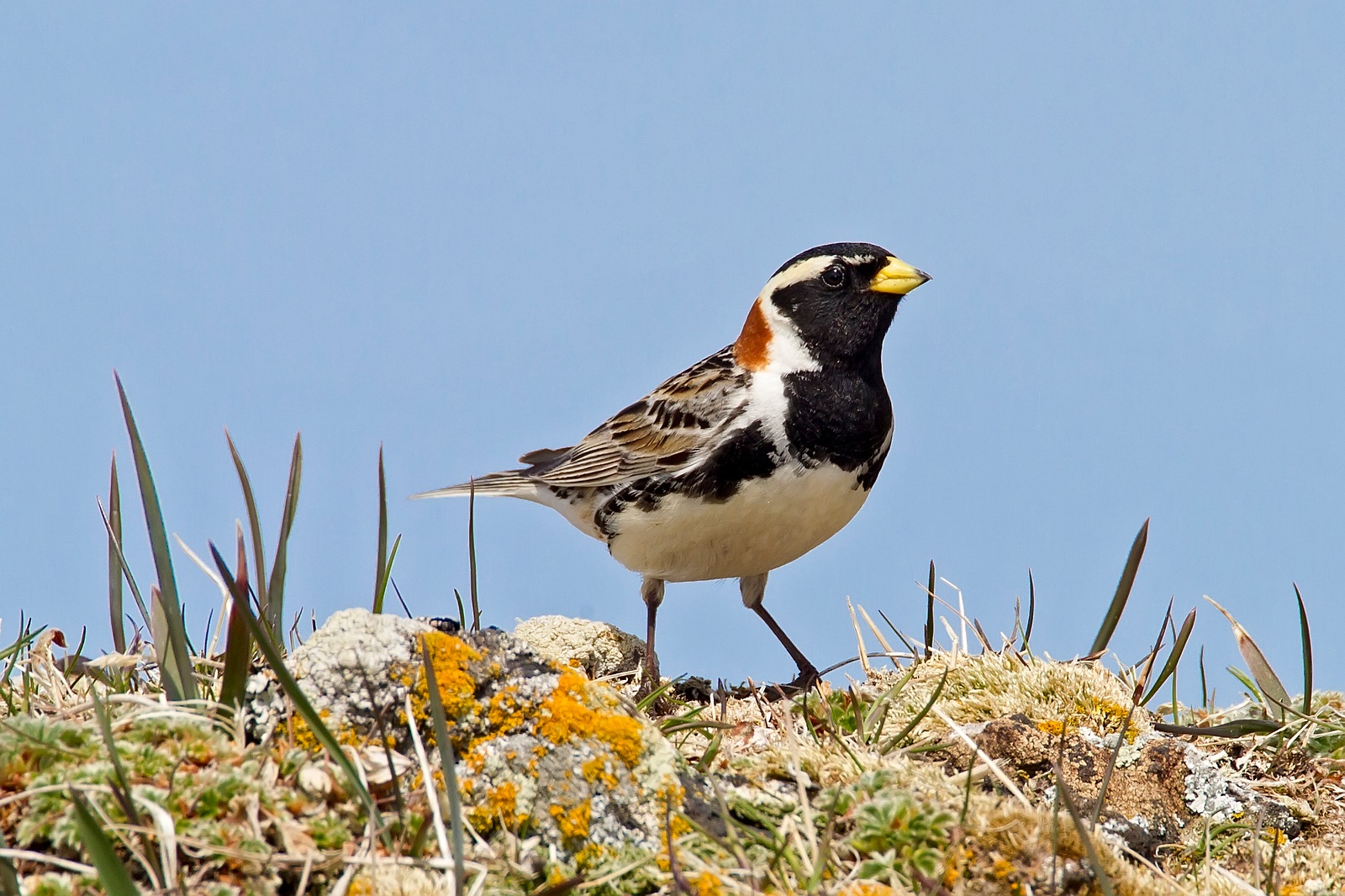 Lapland Longspur (Calcarius lapponicus) - breeding males in tundra. This is a common passerine breeding in the far arctic throughout the arctic boreal region. Their long back toe (hallux) is the "long spur" characteristic of the genus Calcarius - (Latin for spur).
🕊️🕊️🕊️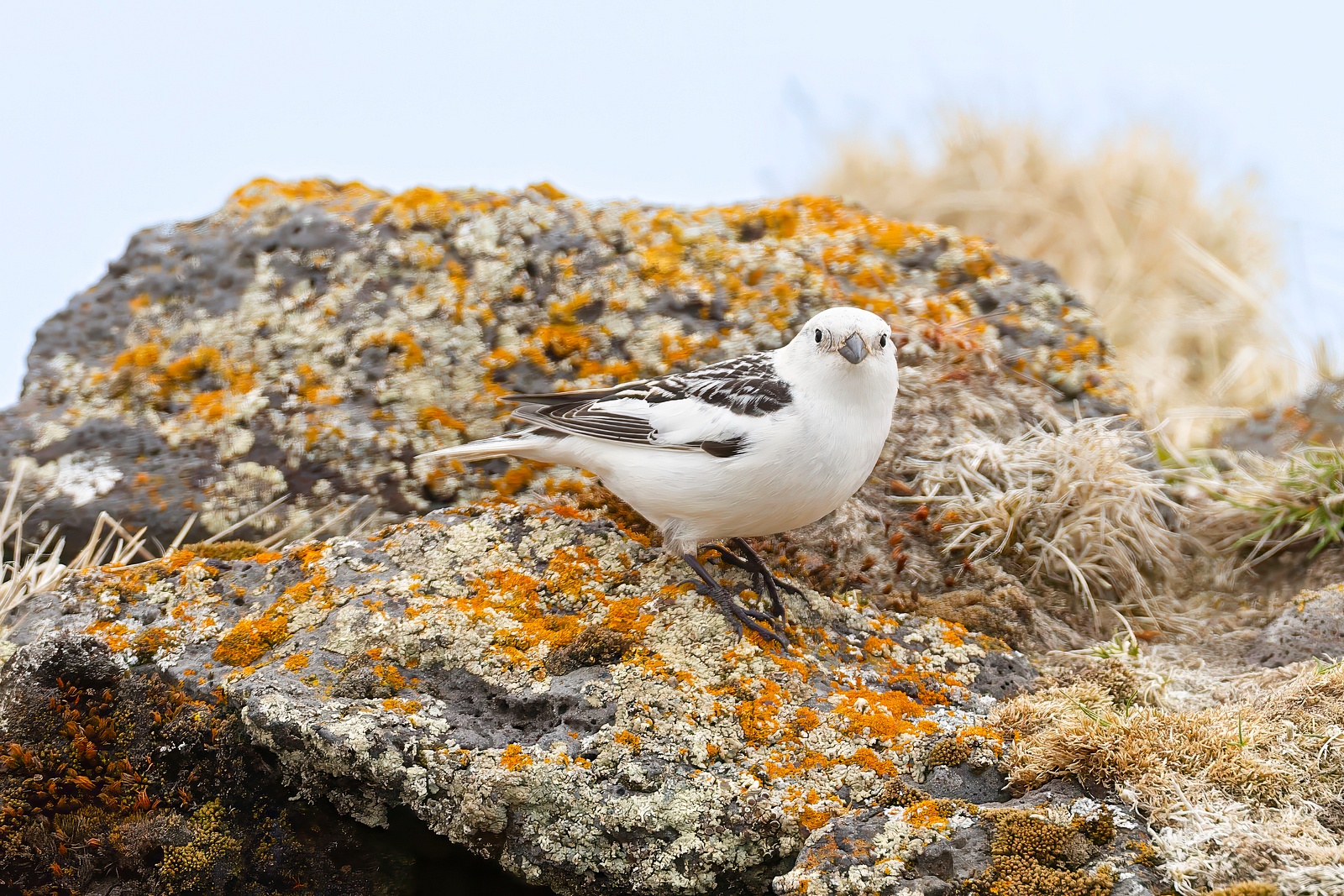
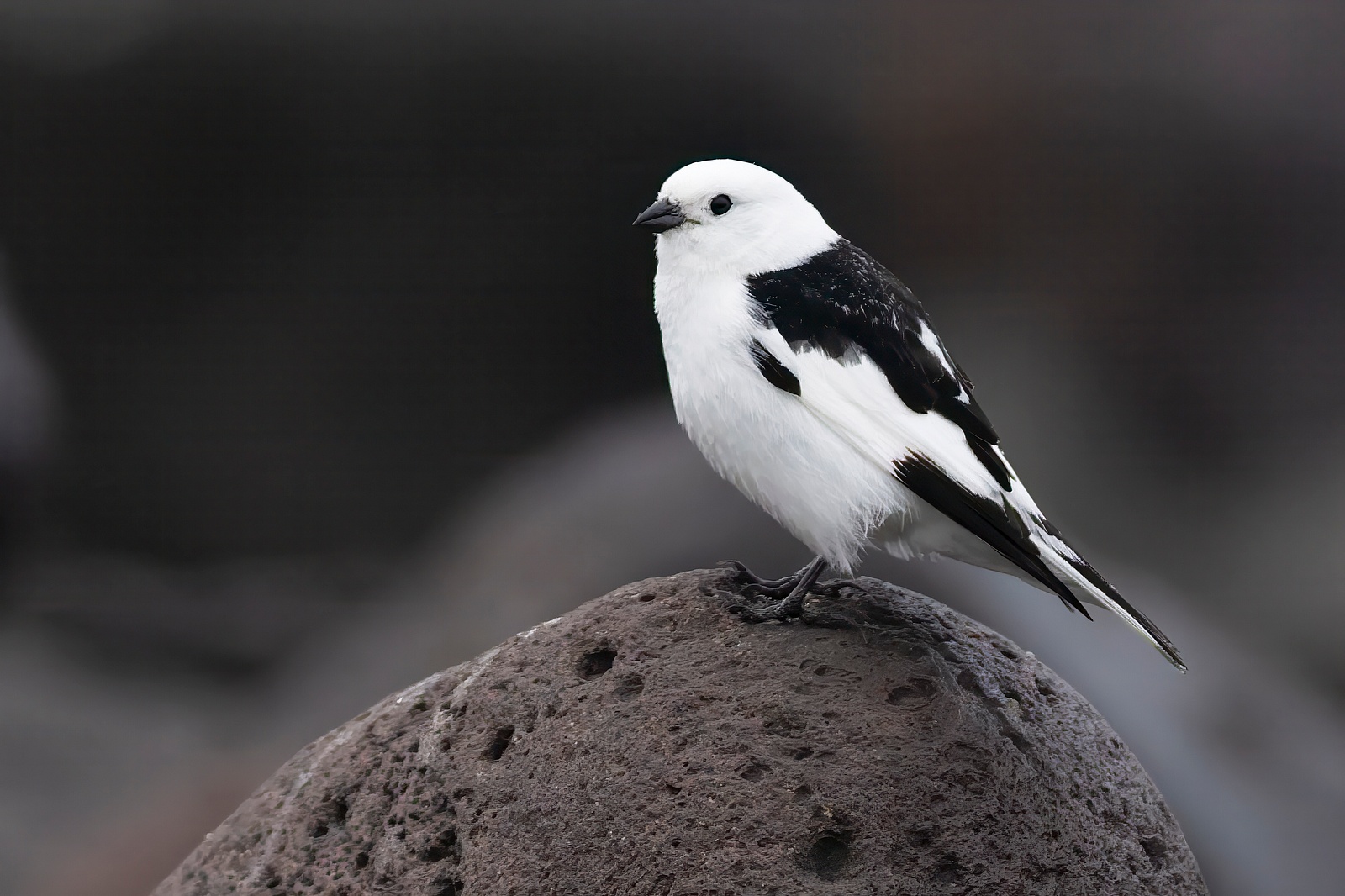 Snow Bunting (Plectrophenax nivalis). Snow Buntings are high arctic specialists with a circumpolar breeding range. They nest in tundra with lichen-covered boulders, building grass-lined nest in deep narrow cracks in rocks. These are prime sites for other tundra songbirds and nest competition is often severe. Only the female incubates the several eggs which hatch near synchronously. After fledging, they molt into their brownish plummage fly south to their winter in southern Canada and northern US.
🕊️🕊️🕊️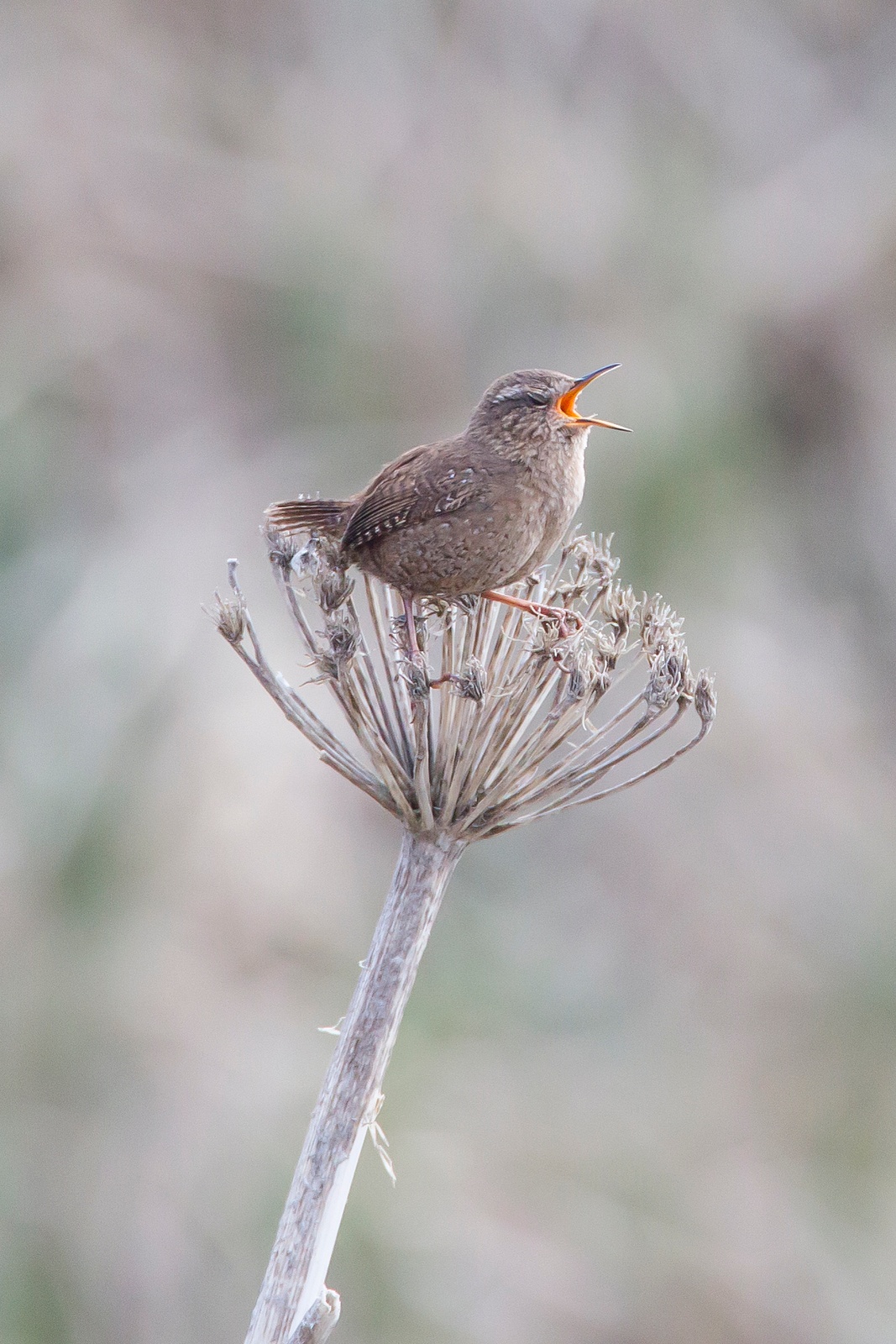
Pacific Wren (Troglodytes pacificus) This tiny wren (4" length) differs from its closely related species the Winter Wren primarily by its song and slightly darker plummage. They occur from southern California to the Aleutians and Pribilof Islands. This was photographed at top of cliffs at Ridge Point.
Flowering Plants
Plants on St. Paul Island have an acutely short growing and flowering time. Nevertheless, 182 species of flower plants have been recorded on this island. Most of these flower during late May, June and July. An excellent key and description guide is that of Dorothy A. Wallace-Senft "The Plants of St. Paul Island, Alaska." This is unpublished but is available online at www.stpaulislandtours.com . As I was primarily photographing birds on this trip, I only photographed a dozen wildflowers on this trip. Here are a few:
Rock Jasmine (Adrosace chamaejasme ssp. lehmannlana) grows in clumps preferring well-drained rocky scora soil such as this weathered volcanic soil of St. Paul Island. This member of the primrose family (Primulaceae) forms cushion-clumps with flowers about 4" tall. The elliptical, basal-leaves are covered with hairs (trichomes) and thin runners give rise to additional clumps. They are early bloomers peaking in late May and early June. Because of their strong fragrance, the Aleuts words for this species are "smells good popcorn flower." This species occurs throughout similar circumboreal regions and in the Rockies, Alps, Himalayas and coastal western Canada. 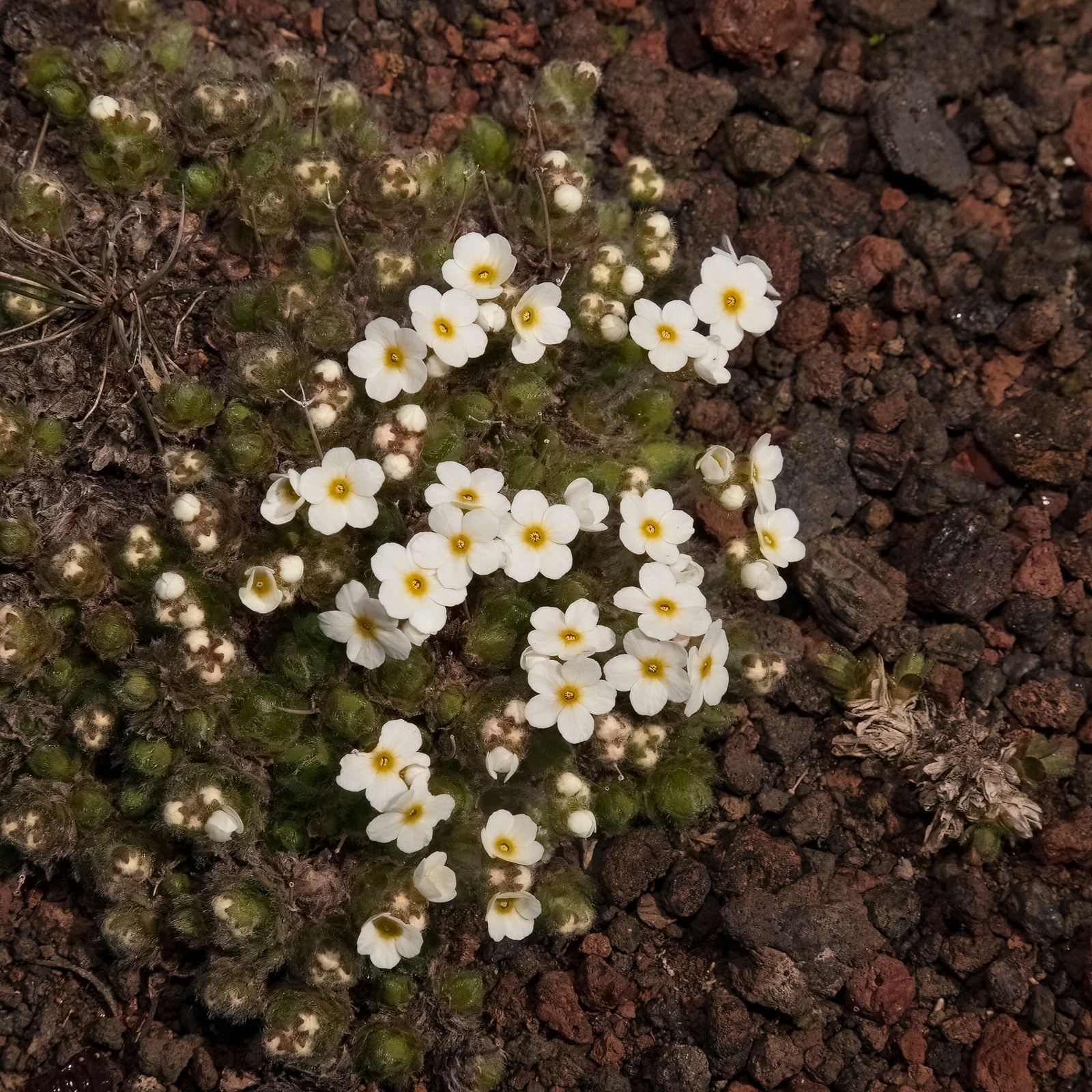
🕊️🕊️🕊️
Arctic Willow (Salix arctica) (family Salicaceae) is the fartherst north growing woody plant. This tiny creeping willow is widely distributed throughout the circumboreal arctic tundra in both dry and wet conditions. This individual was photographed on Hutchinson Hill in mid June. The red catkins are male flowers (note the yellowish anthers with pollen). These plants are tiny (1-3" tall) "trees of the arctic" that are exquisitely adapted for the harsh -70F temperatures and harsh winds of this habitat. Like other tundra plants, their tiny leaves (lower side on this species) are covered with abundant hairs (trichomes) which act in moisture conservation and minimizing frost damage (inhibit ice crystal formation that penetrate epidermal cells). They grow in clumps, closely adherent to the ground, conserving ground warmth. Their roots are shallow, absorbing nutrients from the top few inches of soil, above the permafrost. The resident Reindeer herds use this as one of their primary food sources as do Arctic Hares and Lemings. -Habitat-14-20120622.jpg)
🕊️🕊️🕊️
Nootka Lupin (Lupinus nootkatensis) is a spectacular tundra plant that produce beautiful blue-flowered, 1-3 foot stalks in mid June. It occurs commonly along the Pribilof and Aleutian Islands, southern Alaska and the west coast of North America. It also occurs in Europe and is a difficult invasive species in Iceland. Like other tundra plants, its leaves and seed pods are covered with fine hairs (trichomes). Not only do these help insulate the plant but they are also critical in capturing water from the summer fogs that shroud the Pribilof islands. This species is important in soil reclamation as it, with the help of its root symbiotic bacteria, fix atmospheric nitrogen into a form that can be utilized by the plant. 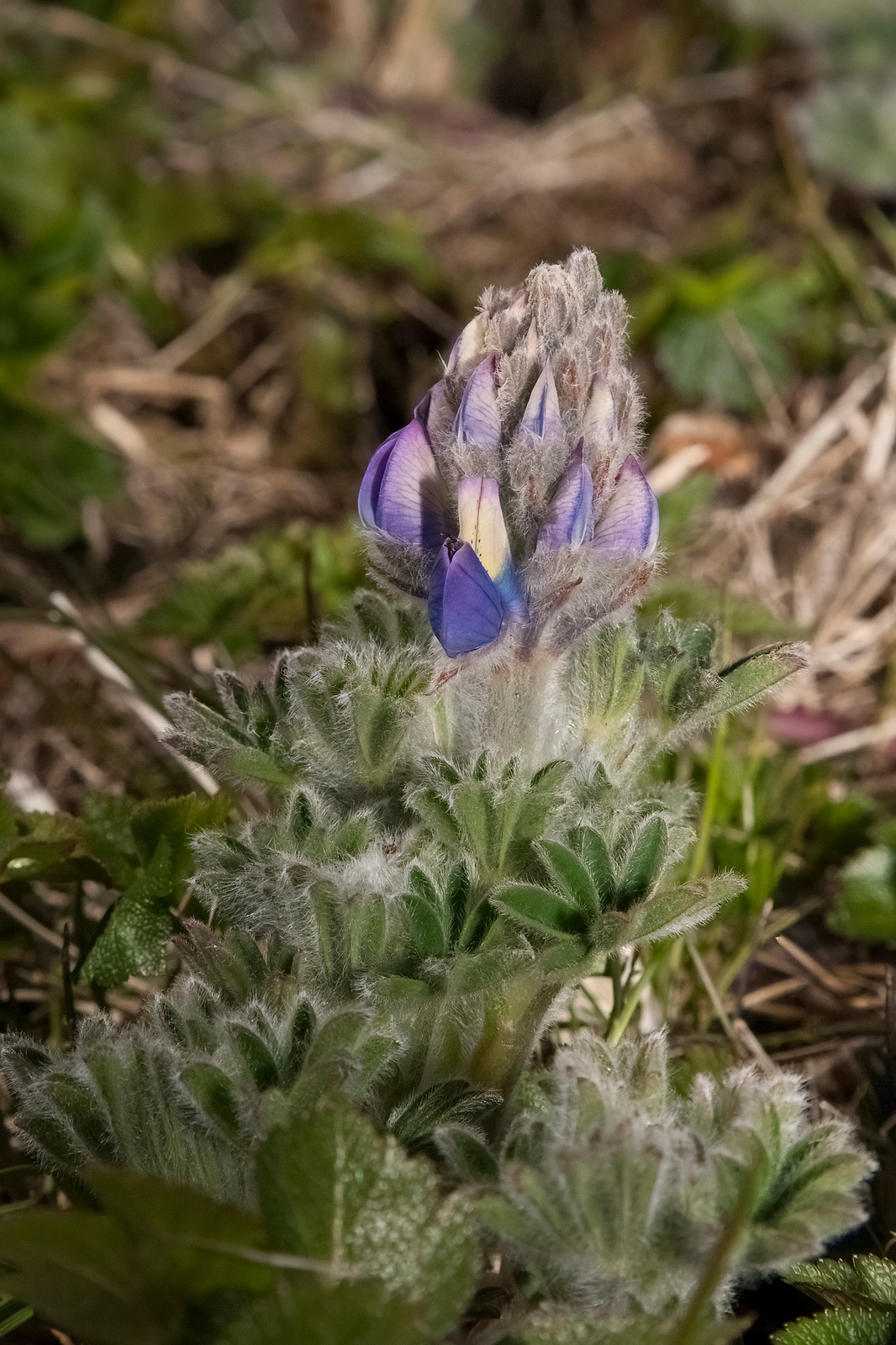
🕊️🕊️🕊️
Lichens
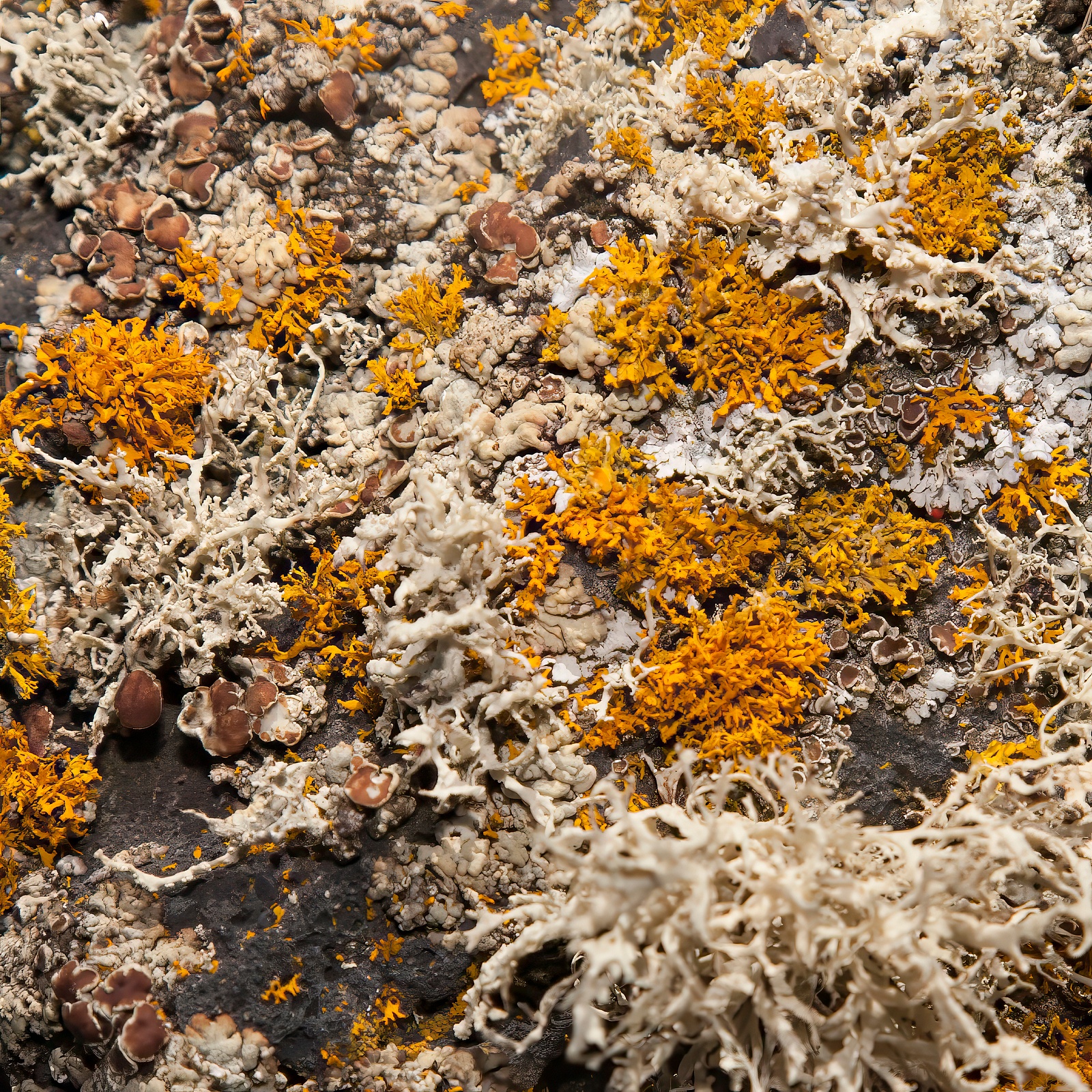
Lichens are an important photosynthetic component of circumboreal communities and are critically important to the survival of the introduced reindeer herds in the Pribilof Islands. They are symbiotic organisms composed of specific fungi and specific cyanobacteria (and infrequently green algae). In St. Paul and its neighbor, St. Matthew Island, 139 species have been identified (The Bryologist 164(1), (2001), pp. 47-58). On a typical tundra boulder as seen below, a variety of species may occur, crowding every inch of available substrate. Lichens are amazing in their abilities to survive the extreme harsh conditions of the arctic. Several adaptation enable these organisms to survive: They can become nearly dormant metabolically during the harshest of the seasons. But even when frozen to -20C and dry, the cyanobacterial symbiont is able to photosynthesize, protected by their associated fungal partners. Lichens are able to absorb moisture (without roots) from snow vapor, ice, and atmospheric moisture. They survive intense DNA damaging UV-b radiation, reflecting these harmful wavelengths and absorbing them with their protective sunscreen pigments (produced by the fungus symbiont) (often yellow, orange, red). Their slow growth (<1mm/year in some species) require relatively few nutrients.
🕊️🕊️🕊️
A Few Important Island Mammals
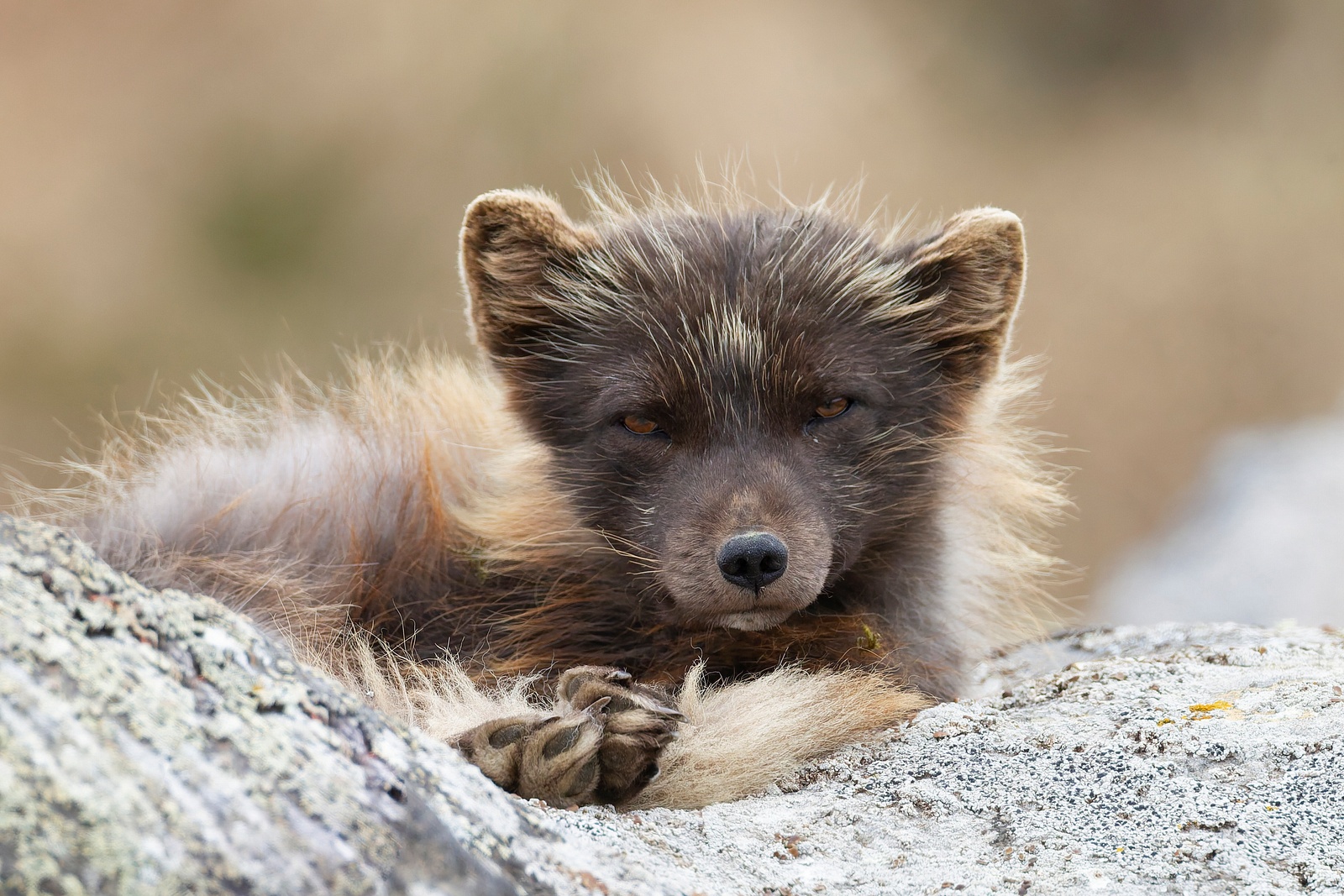
St. Paul Blue Fox (Vulpes lagopus) is a subspecies of the circumboreal winter-white Arctic Fox. Unlike the Arctic Fox that has dark fur in the summer and white winter fur, the Blue Fox subspecies remains dark throughout all arctic seasons. Only about 1-3% if all Arctic Foxes are blue throughout the season. The blue morph is due to one or two mutations in a single (melanin) gene (MC1R); the blue morph allele is dominant over the white morph allele. But, if the blue morph allele is dominant, then why are they so rare genetically?
To answer this, one must look at their evolution. During geologic periods that were much colder than today, coastal seas froze or where covered with extensive ice flows. Woolly Mammoths, Sabertooth Tigers, Caribou, Fox and many other mammals simply migrated across the frozen seas to islands throughout Arctic regions. But as climates warmed, these populations became trapped island residents. Natural selection led to about 1-3% of this species loosing their white coat winter transition and remaining slate-gray/blue throughout the arctic seasons. These only dark morphs were more readily camouflaged for a coastal/island environment. In more inland, colder, snow and ice covered environments, the dark morph would have been selected against evolutionarily. But the white winter morph was selected for throughout snow and ice covered mainland populations.
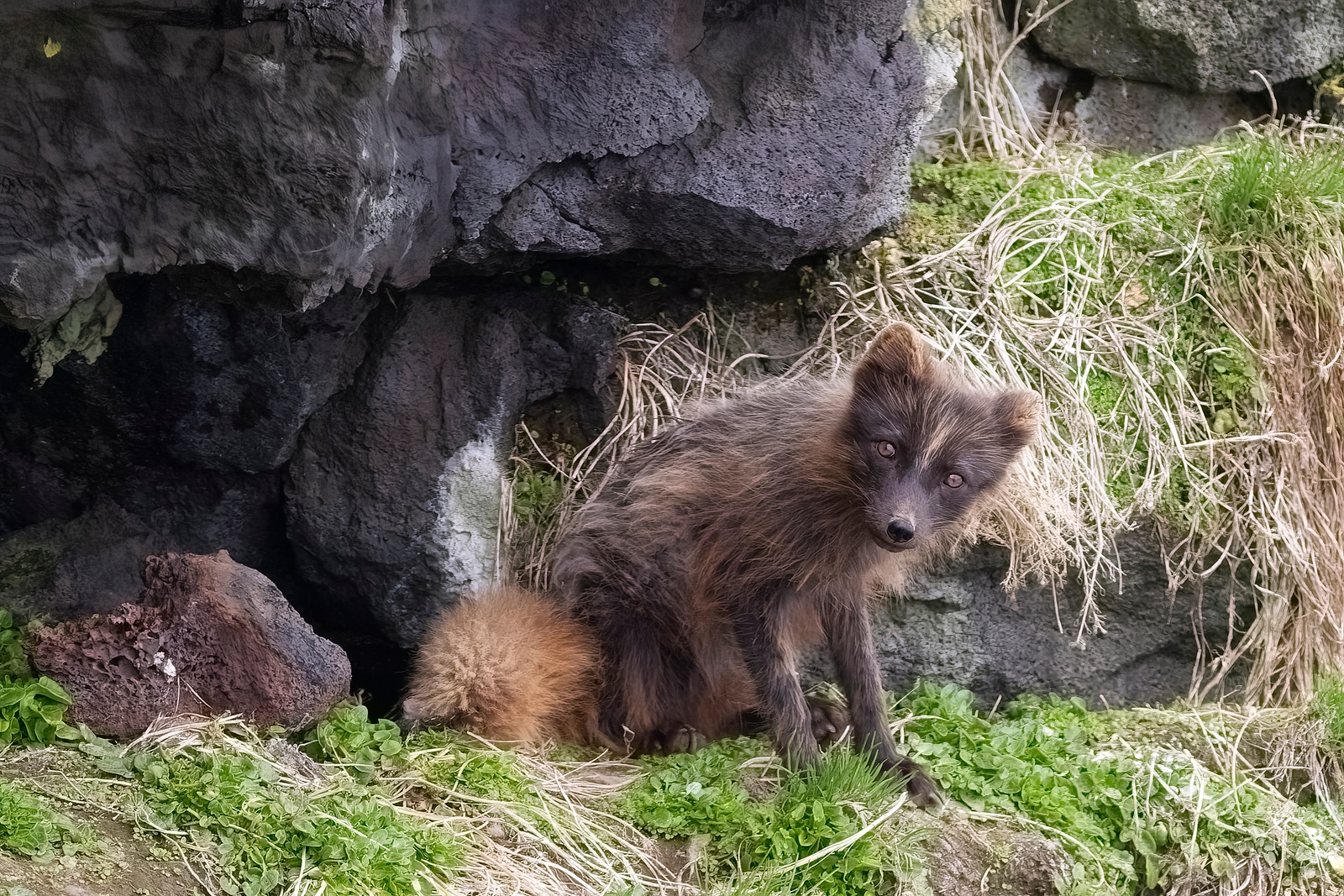
Above: This lovely Blue Fox was photographed among steep high cliffs where it was feeding on nesting seabird eggs. Below is a young independent pup that spent an entire day with me, following me as I photographed among cliffs and boulders along the SW Reef Point Cliff habitats. He never got closer than 3-4 feet from me and spent the hours just watching me. A lovely day indeed!
🕊️🕊️🕊️
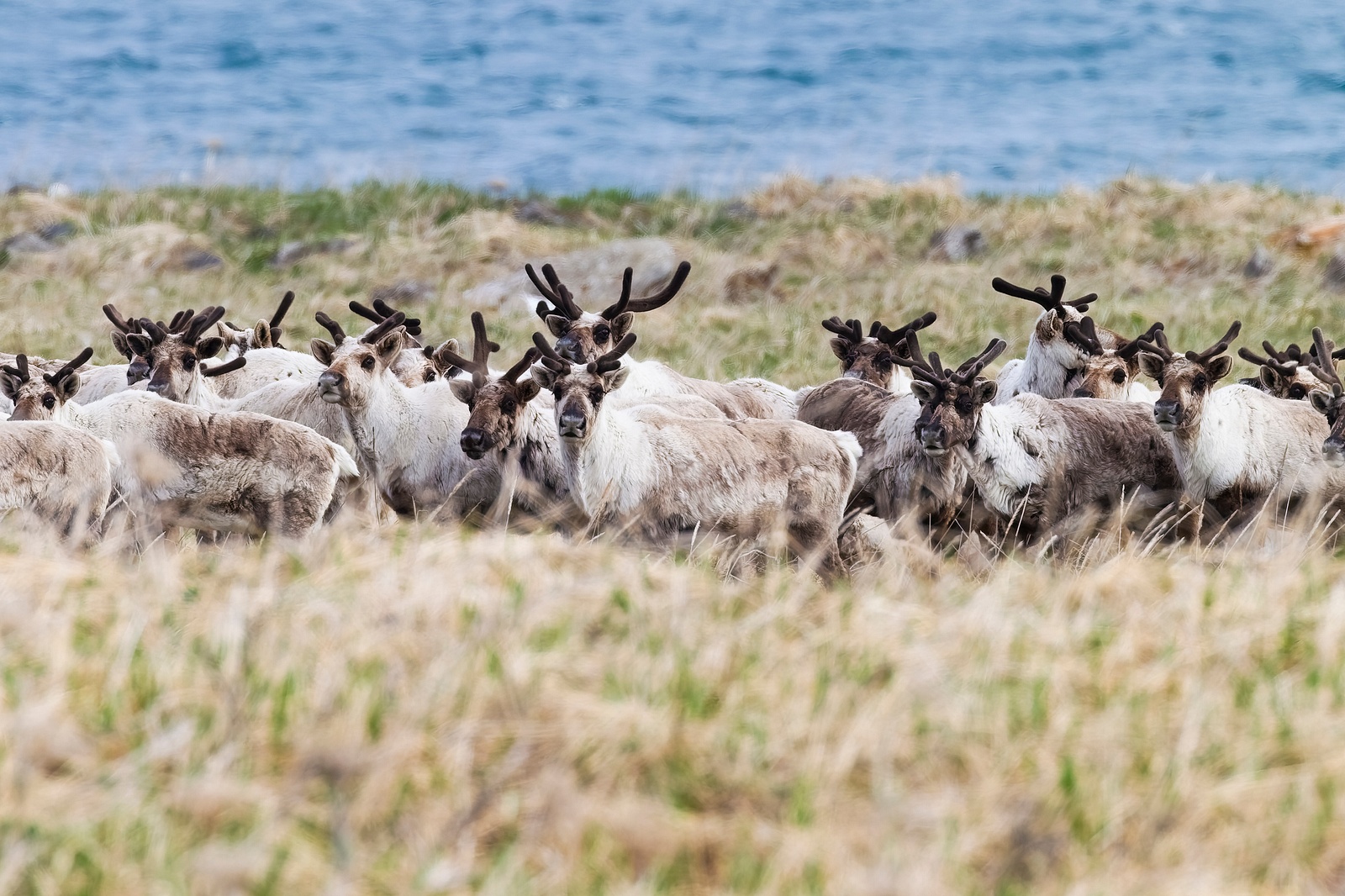
Reindeer Herd (Rangifer tarandus) free-roaming on St. Paul Island. In North America, Reindeer refer to domesticated Caribou. A small herd of Reindeer was introduced to St. Paul (in 1911) for food for the resident Aleut community. The herd grew over the next 4 decades to more than 2000 animals. But, overgrazing of their favorite food - lichens caused the population to crash in the 1950s to 8 individuals. Now the population has is stable about 400 individuals but to survive after over-grazing the islands lichens, they had to switch to other food sources such as tundra plants - grasses, sedges, rushes androots and twigs of woody creeping "trees" including Arctic Willow and Crowberry.
 🕊️🕊️🕊️
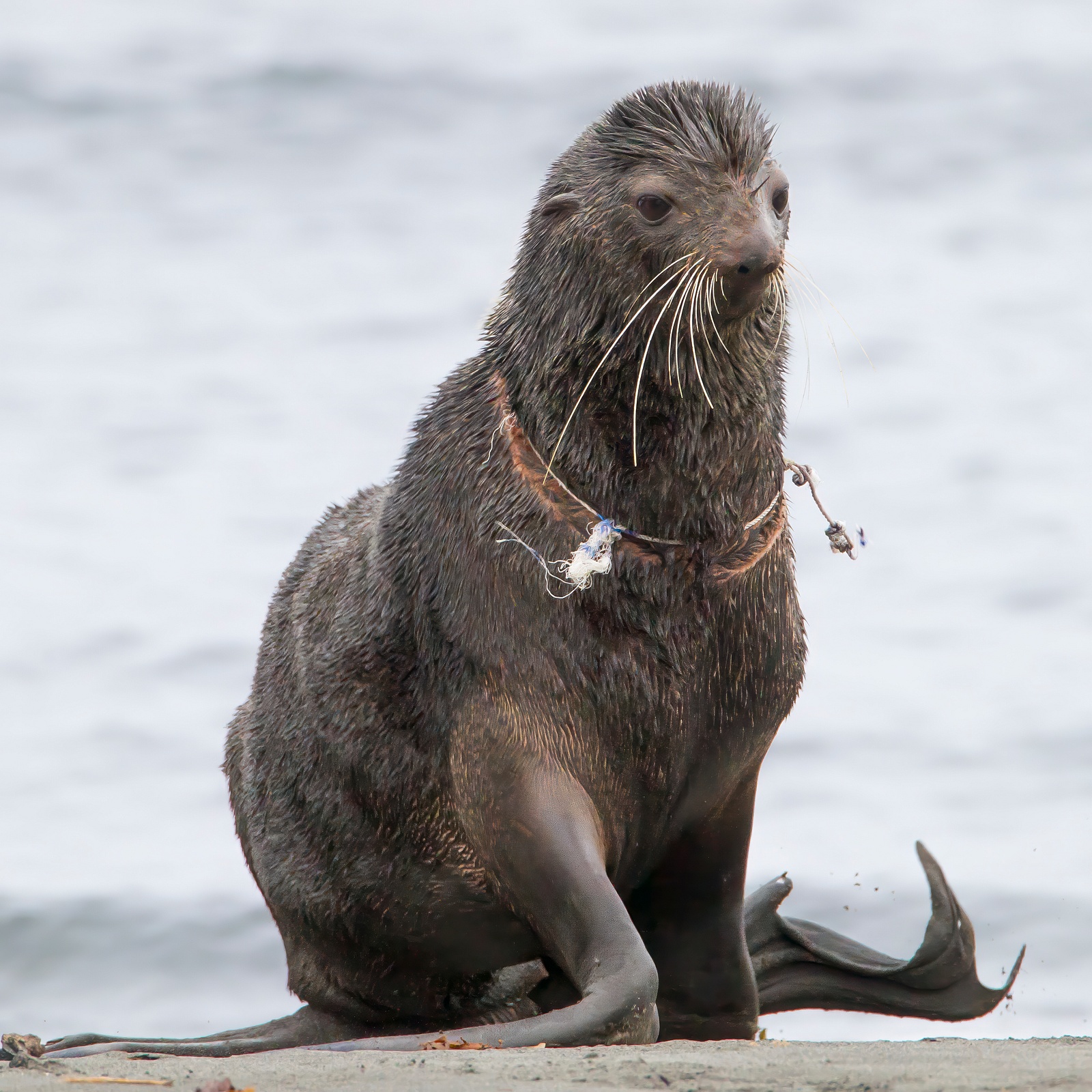
Northern Fur Seals (Callorhinus ursinus) are one of several marine mammal species that occur in the highly productive marine ecosystems surrounding the Pribilof Islands. During the Russian Fur traders of the 1700s, millions of Fur Seals inhabited the Bering Sea, North Pacific and the Sea of Okhotska. Hunting (at times more than 3 million seals a year) took a terrible toll on this species. Now, their numbers are approximately 500,000 or fewer - about two-thirds of the world's population. Although they are now protected from hunting, their population numbers continue to decrease due to warming of surrounding seawater and the resultant decrease in food, occasional toxic algal blooms (saxitoxin has been most recent Dinoflagellate produced neurotoxin affecting this species), and alterations in currents and localized upwelling that feeds the ecosystem that supports these and several other marine mammals. While photographing on the northern side of St. Paul, I came across hundreds of individuals befouled by fishing lines. After reporting this to conservation experts on the island, teams of volunteers attempted to remove the gear from its hundreds of victims. The Aleut Community, in concert with NOAA have worked together effectively to address many of the environmental issues these species face, and to establish an "Indigenous Marine Stewardship Area" for this area of the Bering Sea. 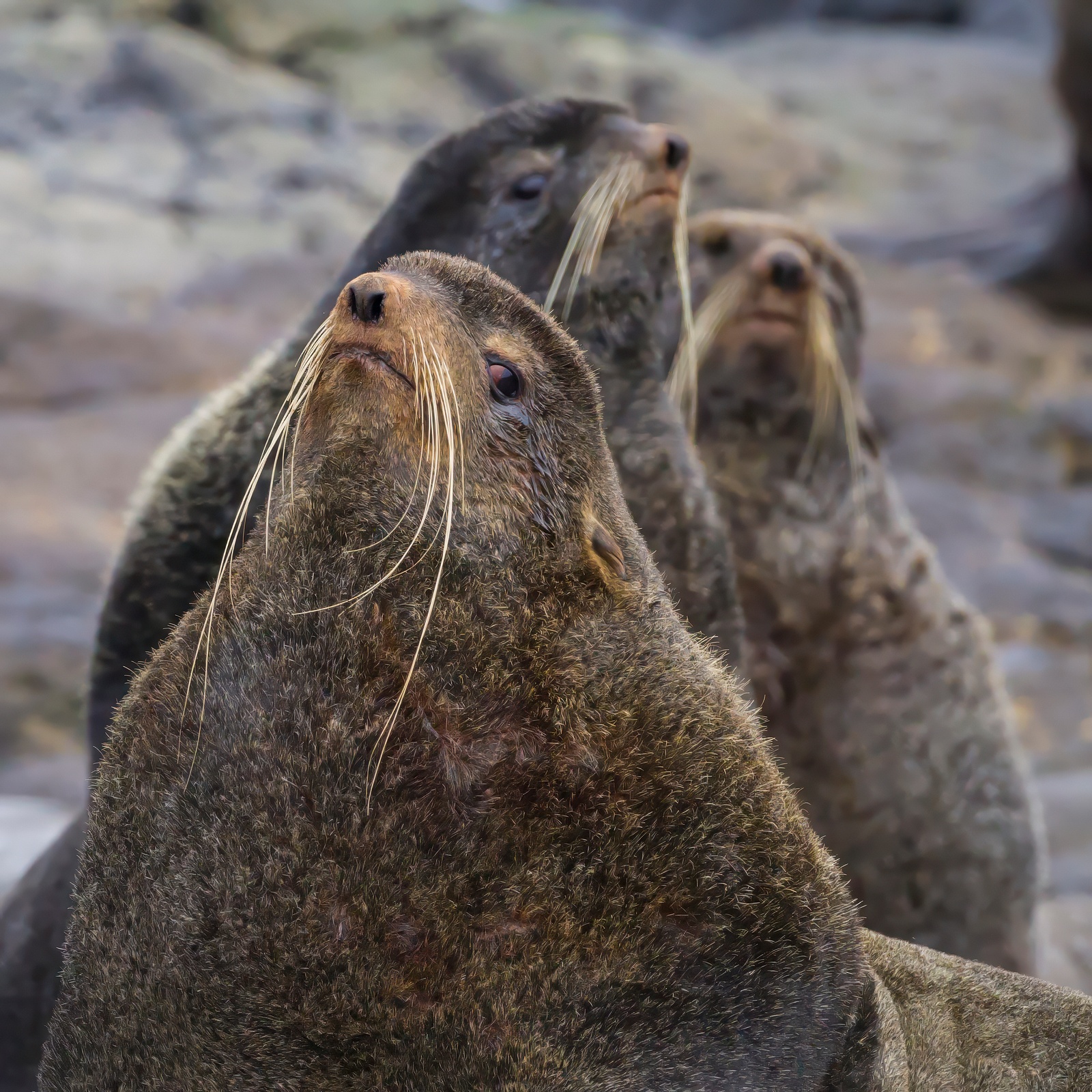
 ) to see how your blog looks